Truth, or Falsies?

It was just a few days ago that I heard it for the first time: the word “falsies.”

Actually, it wasn’t the very first time I’d heard the word; rather, it was the first time I had heard it used to refer to something other than that to which I had first heard it used.

Okay. Okay. I am back pedaling, aren’t I?

Bosom pads for breasts. Falsies. We talked about them in junior high school in the 1960s when our hormones were kicking in. Of course, nowadays kids are probably talking about them in elementary school. Kindergarten, perhaps? Is there no innocence?

BUT . . . the way I heard it used the other day . . . it made reference to mascara, a Maybelline makeup product. That one was new to me.

The subject of cleavage enhancement has a long history, dating back to the Victorian era. Evidently we aren’t the first folks to engage in serious image management. We human beings aren’t comfortable with “the naked truth,” as a quote I often employ says. It continues: “so we want to cover it up just a little bit.”

The word “false” originally carried with it the notion of “fake” or even “deceitful.” We seldom think of it that way when we answer a bunch of True/False questions; we tend to think more along the lines of Right/Wrong, or Correct/Incorrect.

But when we use the word “falsies” we readily understand that fakery and deceit are implied, even when we may have no intent to do harm with that deceit.

Which brings me to the reason I thought about writing this blog entry to begin with (I know, some of you are thinking, “why doesn’t he just get ON with it?”). Sorry! The writer’s mind is a complex and confusing arena filled with hungry lions and unwitting gazelles.

I have a false tooth.

There! Are you satisfied now?

Several weeks ago I was eating a quick lunch before hurrying off to one of my part-time jobs. I was eating and talking, and . . . crunch! All of a sudden I bit down on my metal fork, and it felt like my bottom front teeth collapsed beneath it. When I looked for the damage in the mirror . . . there was nothing.

The tooth in question continued to hurt; it was somewhat loose, too. I knew I was in for a dental visit but I put it off for another day, and went on in to work.

The next morning I sat in my dentist’s chair awaiting the official verdict. I could see the X-ray for myself on the computer screen nearby – it looked like the internal resorption I had experienced a few years ago. The roots of the tooth were just a dark mass. Ugh!

A trip to the endodontist made it clear that a root canal and subsequent crowning would not work on this tooth. So, I returned to my dentist for an extraction. I was informed that replacing the tooth with an implant (if it was even feasible in that spot) would cost about $5,000.00. So, I asked for the cheapest option, and agreed to it post haste.

Goop was stuck in my mouth, it hardened quickly so that a mold was formed, and then someone in a distant location created an appliance with ONE TOOTH on it. Tailor made for my mouth. How flattering!

My family has enjoyed fits of laughter over this, of course. They liken me to my wife’s parents (who haven’t hardly had any teeth for 40 years); they soak their false teeth in a container every night (at least I HOPE they do), so if you speak to them just before they retire at night you may engage in a brief conversation with a toothless elder.

Sigh.

I have a false tooth.

It is still hard for me to conceive of it as I sit here in this bookstore and write. I am currently not wearing it, so my tongue regularly visits the space between my bottom front teeth and says, “hello.”

When I am wearing it, the appliance (which fits nicely over my gums and is secured by eye teeth) makes me salivate, or at least it causes saliva to collect in large amounts in places it did not collect previously. As a result I talk kind of funny now. I don’t think I would ever try to sing with this thing in for fear of drowning as I took a breath for a long note.

It is difficult to eat with the false tooth in, too. It isn’t really made to tackle steak or anything challenging like that, and even when chewing with my “true” (real) teeth, particles of food get stuck beneath the appliance and play tricks of their own on me.

I am officially old, I guess. In two months I will be a mere 62, but . . . clearly I am old. False teeth DO NOT LIE! They always tell the TRUTH.

Part of what makes this difficult is that my parents (who both lived into their late 80s) never had to have false teeth. Sure, they had crowns, bridges, etc.

But nothing FALSE.

Am I being deceitful when I wear my deceitful tooth? Am I a fake?

That question is one for those who deal in metaphysics, I suppose. Not for those of us who simply want to appear to have a full set of teeth.
Posted in Comedy, Family History, Stories, Uncategorized | Tagged , , , , , , , , , , , , , , , , , , , | 5 Comments

It’s a Small World

Richard and Robert Sherman penned these words for the 1964 New York World’s Fair. The song, which arguably is the most translated and performed song in history, was written by the most prolific motion-picture musical songwriting duo of all time. It has come to be so closely associated with Disney as to make the two interchangeable.

Indeed, it is a small world (after all). That is, in spite of great distances, various languages, differing cultures, etc., there are uncanny personal connections which continually emerge. This may be due, in part, to the internet and the speed of modern transportation. For seldom does a day go by that I do not hear or read of another example which illustrates our “six degrees of separation” (put forth by the Hungarian, Frigyes Karinthy, 1929; then John Guare, 1990).

It is truly amazing.

Our world has shrunken. And because it has we have become more cosmopolitan in our outlook. We discuss world peace, world hunger, global warming, and issues with universal implications. And we are quite at home in doing so.

But I have come to see that there is at least one aspect of life where our world is exceedingly small; where it is a “small, small world.” Not because we have opened our arms so widely as to encompass the globe. And not because our perspective has become so universal.

On the contrary. It is because, in at least this one regard . . . we truly become small; that is, we retreat into ourselves, and in a very real sense, “our world” is reduced almost to the size of our own person.

Of course, I am speaking of death. Not a popular subject, I understand. But one which touches us all at various moments of our lives. And . . . ultimately, at one particular moment: our own death.

I first was made aware of this when my late mother shared with me her observation of my father just days before he passed away. She said he seemed to be retreating into himself; she felt the distance from him, personally. It was as if he was retreating to a place only he could go; there was no room for a shared experience.

And then I observed it in her, too, just before she passed. Admittedly, it is hard to evaluate the effect of some of the drugs she was on (to relieve her from the drowning feeling of her cardio-pulmonary hypertension), so I can never say her “distance” was in no way drug induced.

My father rallied on his last day, singing and enjoying a nice dinner. Then he was gone. Mother rallied, too, but only long enough to have a one word conversation with the nurse at her bedside. Then, she too, was gone.

Mortality.

If one is not killed instantly in a bomb blast or a car accident, etc., but has time to experience days/weeks preparing for his/her death, then I wonder if it is fair to say that his/her world gets smaller and smaller. It gets smaller until it reaches a place where introspective focus is complete, the focus puller adjusting to the changing distance between actor and camera.

No doubt, we live together in a world of laughter, tears, hopes and fears (as the song says); there is so much that we share. It is a small, small world.

And yet . . . .

We could say there is a sense in which that world gets larger and larger at death, so large, in fact, that it is too enormous for us to continue to embrace. We cease talking globally, our perspective diminishes, and we can only put our arms around ourselves.

Oh, we may hold the hand of a loved one, a life mate, a close friend or a child. And we may smile and express our love (if we are able to do so). But . . . “our world” may be bound by the four walls of a room in which we lie, or smaller yet – it may be limited to the confines of our mind.

We grow up from infancy, learn the importance of interaction with others, align ourselves with friends and/or life mates, and live out our lives in community. But when the end approaches, when our final day(s) arrive, when it is time for us to sing our swan song, leave the stage once and for all, and leave the audience we entertained with the task of evaluating our act . . .

We go behind the curtain alone.

Posted in Aging Parents, Assisted Living, Family History, Nursing Homes, Stories, Uncategorized | Tagged , , , , , , , , , , , , , , , , , | 4 Comments

Anatomy of a Writer

What makes someone a writer?

My mother was a great writer. I could say she “had a way with words,” but that might not tell you very much. I can say that whenever I read something she wrote I find myself smiling at the pictures she paints with words, and that the word “clever” often forms itself on my lips.

There was a cuteness in the way she delivered a sentence, an adorableness that seemed to be tucked in between the words, like the smell of lilacs announcing the coming of spring.

Frederick Buechner is a great writer. My cousin, John, is a great writer, too. As is my uncle, John. [Maybe it’s in the name? My own name, of course, means John in Russian.]

It is easiest, of course, for me to discuss my own writing; therein I can give you first hand information. But I must warn you: some of this may not be pretty.

You see, I am enamored with words. Words pass through my mind’s eye like wild birds darting to and fro in the garden: each has an important mission, but you cannot always tell what it is.

When I listen to a person talk I am constantly evaluating his/her choice of words, syntax, and manner of delivery. If I catch an allusion to another subject with parallel word usage I am tempted to make a joking comment exposing that allusion. If I note an error in syntax I am apt to pull it into the light. Let’s just say I will make the most of an error if I can do so. And all of this happens without conscious intent. It is automatic. It is in the DNA of the writer.

I understand I have just painted myself in a very poor light. Forgive me.

You see, I am a recovering wordaholic.

Part of the skill set necessary to being a writer includes a mind that scrutinizes words: their denotations, connotations, and the overall historical context into which they fit. The honing of this skill sometimes lends itself to negative personal interactions.

Another part of my writer’s psyche concerns itself with pronunciation. This, too, is a sensitive area; many people have trouble with pronunciation. But to a writer, the mispronunciation of a word spawns an opportunity for the creative juices of allusion to flow.

Archie Bunker notwithstanding, communication still continues to happen with a modicum of success in our world. But to a writer like me, the Archie’s of this world make it a great deal more fun in which to engage.

The conundrum, of course, is that the wordaholic is apt to miss honest communication with another person by constantly focusing on the tools used in that communication. That is his/her Achilles’ heel. For example, if you are constantly on guard for the double entendre you might miss the whole tenor of the conversation. [Come on, some of you were just now thinking of making a musical remark about . . . oh, never mind].

To me, writing involves paying attention . . . TO EVERYTHING. All at once.

By that I mean that the sounds, hues, flavors and emotional complexes of a word or phrase are constantly on the palette in front of the writer. He/she notices the texture of the walls of the writing room (so to speak), the color of the paint, the ambient sounds (inside and out), the temperature, etc.

Everything informs the writer. The news of the day, the pain caused by a harsh word, the sparkle of sunlight, the smell of fresh baked bread. And from that immersion into life, sometimes even the banality of life, the writer watches the sky of his/her heart for a fowl carrying a word that will somehow bring everything into focus and sensibility.

There is an element of the magical about it all, no doubt. There is a sense in which the writer feels that all these multifarious elements might perchance converge in an instant. And . . . if he/she is watching closely . . . it might be visible in all its mysterious glory.

Then . . . the writer waits for the tidal wave of words, the tsunami of descriptors, the fallout of exposed phrases to describe it.

But alas, I must hurry off to my 12 Step Meeting. “Hi! I’m Ivan. And I’m a wordaholic.”

P.S. But I had intended to write about the anatomy of the writer. There’s not much to say, really. The anatomy of the writer is much the same as any other human being: skin protecting a number of vital organs. The only difference may be that the writer is guided by his/her heart more than by his/her mind.

Wait!

Um. I guess there is no difference.

Posted in Family History, Stories, Uncategorized | Tagged , , , , , , , , , , | 3 Comments

Everybody Knows This, Right?

I have been working in a garden from time to time at one of my part-time jobs this year. And in spite of my ripe old age I have actually learned a little in the process. I learned that cotton has a beautiful bloom, as does okra, artichoke, and even peanuts (to name just a few).
In fact, just a few days ago I came to a conclusion that astounded me [NOTE : I am still in the first grade when it comes to gardening]. I had always thought that flowers flowered, and vegetables vegetabled (or some such creative word), but now I know that . . . [wait for it] . . .

Vegetables flower, too, just like flowers flower; and their blooms are beautiful!

Maybe you’ve never had a revelation like that in your life. You know, something that probably everybody else knows – except YOU.

Have you ever listened to other people discussing a subject and find yourself thinking, “I must have missed that year in school”? As I mentioned in a previous post, I was in my 50s before I learned how to correctly set the side mirrors in my car.

I have always assumed that government agencies like the FDA (Food and Drug Administration), the EPA (Environmental Protection Agency), etc., all functioned with the same basic approach to approve products in the U.S.A., i.e. exhaustive and strict testing is done before a product is made available to American consumers. And I have been glad that our country scrutinizes first before allowing anything that could endanger potential customers.

But I was wrong.

I learned just this week that the EPA operates under a very different standard than the FDA, i.e. a product is innocent until proven guilty (employing a common legal notion of ours). This has allowed the American Chemical Council to protect large chemical corporations from environmentalists who find numberless everyday products on our grocery and drug store shelves to be dangerous to consumers. The chemical lobbyists are a formidable force, and the almighty dollar once again reigns supreme. Even in the good old U.S.A.

But then, everybody knows this, right?

Just a few weeks ago I learned that Prohibition was not just about righteous indignation over the pervasive ill effects of alcohol in our society in 1920; rather, it was, in part, a power ploy by none other than John D. Rockefeller to defeat Henry Ford and his ethanol using Model T Ford.

As a boy I was taught the cause of the Civil War had to do with the moral question of slavery, and that Abraham Lincoln was a champion for the equality of the negro race. Since that time I have come to understand that Lincoln (whom I admire greatly) was influenced by a number of political expediencies when he wrote the Emancipation Proclamation (which became official in January 1863). And that things are not always as cut-and-dried as they may first appear.

Everybody knows this, right?

As a professor in graduate school shared with me years ago, R.D. Laing wrote in Knots:

“There is something I don’t know that I am supposed to know.
I don’t know what it is I don’t know and yet am supposed to know,
and I feel I look stupid if I seem both not to know it and not know what it is I don’t
know.
Therefore I pretend I know it. This is nerve-racking since I don’t know what I must
pretend to know. Therefore I pretend I know everything.
I feel you know what I am supposed to know but you can’t tell me what it is because
you don’t know that I don’t know what it is.
You may know what I don’t know, but now I don’t know it, and I can’t tell you. So you
will have to tell me everything.”

We are all lifelong learners, you and I. And if we keep our eyes and hearts open there are countless discoveries ahead of us, some are even life changing, “game changers” (in today’s vernacular).

Doubtless there will be times when you think to yourself, “Everybody knows this but ME.” But no matter! Everyone else is in the same proverbial boat, alternately taking in water, then sailing ahead with the wind at his/her back.

The trick (if it really is a trick) is to refuse to pretend.

Posted in Family History, Stories, Uncategorized | Tagged , , , , , , , , , , , , , , , | 8 Comments

Senior Class

There’s nothing quite like your Senior Year, is there? Whether it’s in high school or in college, there is a status that goes with being a senior. You have finally arrived, reached the plateau, climbed to the summit.

My senior year in high school was in Tucson, Arizona in 1970-1971. I could finally walk on the official school seal that year without fear of repercussions. After all, I was a senior. There were privileges to be had.

Of course, by the time I reached my senior year I came to understand that there weren’t as many privileges as there had appeared to be in the years leading up to that one; sort of like there was a senior mirage visible only to underclassmen.

You see, my junior year had been filled with an anticipation that was hard to contain; I was about to reach the apex, the ultimate freedom. But when I actually got there, there were harder classes to take, plans for the future had to be defined and pursued, and my responsibility meter was expected to be in rare form.

Not all that long ago I reached another plateau in my life. Another senior year (if you will). This more recent status gives me small discounts at Kroger on Wednesdays, cheaper coffee at certain restaurants, and less expensive tickets at the movie theater.

But now it’s not a senior year; rather, it is called senior years (plural). And there are privileges to be had. A few, anyway.

People who I think are about my age call me “Sir” often. And sometimes I am passed by when someone is in need of some “heavy lifting” (you see, they scan the audience of persons in front of them, look right past me, and secure the services of someone who can’t be more than 10 . . . well, maybe 20 . . . aw heck, probably 30 to 40 years younger than me).

You see, I am in The Senior Class. And there are privileges to be had, right?

At least, that’s the picture I had . . . the way it appeared to me . . . . Hey! Don’t tell me that was another senior mirage!

Like it or not, privileged or not, I am a part of the senior class. And with that status comes (you guessed it) responsibility.

How many times have you gone into a bank, post office, doctor’s office, grocery store, department store, convenience store, coffee shop, restaurant, or any public place and witnessed seniors angry about the service there? It’s almost as if there was a memo sent to all senior citizens, instructing them to be bitchy (pardon my French; actually its roots are in English and Old Norse, etc.) on any given day.

“Old people,” it is often said, “are just grumps.” And sometimes this is due to the fact that they no longer can see very well, hear very well, move about very well, recall the right words to say, or even think very clearly. That is enough to make anyone grumpy.

On the other hand, it is sometimes due to the fact that seniors . . . (bear with me now) . . . have no class.

At a time in life when one should be able to bring decades of experience (both good and bad) to the table, the benefits of both success and failure in life, the seasoned precision, reliability, and wisdom of a class act both tested and proven in the smelter of living – there is often nothing to show but a bitter, frustrated, impatient and demanding old senior.

I do not want to be part of such a senior class.

“With privilege comes responsibility,” it has been said.

I open doors for seniors (and others, too), because I think it is appropriate to honor our elders, and also because sometimes older folks are too weak to do this for themselves. When my mother became feeble and I had to care for her, helping her in and out of her wheelchair, etc., I became more aware of older folks and their struggle to do the simple things I take for granted.

Now, every time I see someone helping an elderly person into or out of a car, or into or out of a wheelchair – I think of my mother. And I respect them for helping.

This is all right and good. And I hope our society never loses this sensitivity and respect for those who are weaker, or older (however, I do see this eroding).

But doggone it! It is also right and good for the senior class to lead the way: exemplifying respect for others, patience in adversity, a cool head in the midst of turmoil, and high character in the face of corruption and scandal.

As a senior, you are responsible. You realize that the mirage of privilege is just an illusion.

And you approach the challenges of the current day with what could rightfully be called “senior class.

Because you have not finished!

Commencement is coming! Act accordingly, with the dignity that accompanies your elevated status.

And at all times, in all circumstances, never fail to exhibit . . . Senior Class.

Posted in Family History, Stories, Uncategorized | Tagged , , , , , , , , , , , , , , , , , , , , , , , , , | 5 Comments

All About that Bass

Meghan Trainor rapped, “It’s all about that bass,” and gave birth to a phrase that swept the world in 2014. And a flexing, bandana wearing Rosie the Riveter, along with the phrase, “We Can Do It,” created nationwide support for the war effort during the 1940s.

We are a phrase loving world, and we delight in using catchy language to promote our causes. And rightly so. Our advertising industry has made an art out of creating slogans that are memorable.

My father used to say, “An apple a day . . .” (you know the rest, of course), and he taught me the word pectin.

And weren’t we all raised with the phrase, “Cleanliness is . . . .?”

Our lives are filled with slogans, aren’t they? “Be All That You Can Be.” “Just Do It.” “We Bring Good Things to Life.” “Let Your Fingers Do the Walking.” It is endless.

Whether we are flying the friendly skies, or trying to stop a Trane, we are engulfed with phrase after phrase of various ad campaigns, and our memories keep them alive for a lifetime.

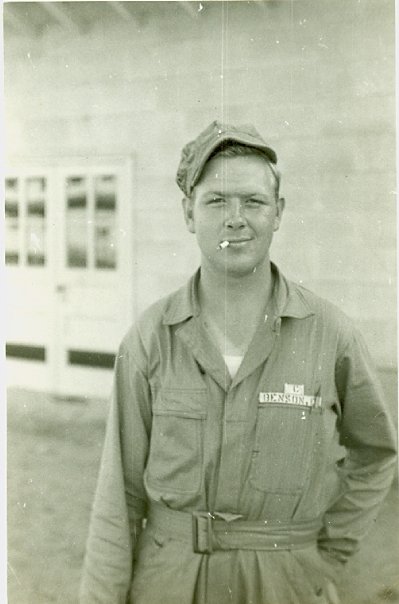
But I am intrigued as I write today, because “all about that bass” is personally memorable to me. You see, I can’t see the word “bass” without thinking of my father, Edward Ludwig Benson, who passed from this world on April 9, 2009 in Tucson, Arizona. My father was a singer, a bass, a basso profundo.

On this Memorial Day, May 25, 2015 I am reminded that for me, it is truly all about that bass.

Dad entered the service just after his father died in the spring of 1942. He was trained an an engineer gunner on the B24, then later detached from his unit and asked to carry the top secret Norden bombsight. He caught malaria in the service, drank water laced with tiny bits of glass and ate rations covered with flies in India; he marched through the jungles in Burma where they machine-gunned poisonous snakes that hung in the trees and would drop down on soldiers to apply their deadly strike. “War is hell,” according to William Tecumseh Sherman (who did more than his part to make his phrase come true).

My father-in-law was a belly gunner on the B17, and did his part in the war as well. But his is another story, for another time. I will call him later today, and thank him for his service; he will turn 91 years old in July. Other family members served as well, and to them I am most grateful.

I was deferred from military service. And I will forever have mixed feelings about that. But that, too, is another story.

Today, I am especially remembering my father. His service to our country was exemplary, and he earned medals to prove it. But his life was my own personal example of what it means to be a man. Not everything about him was perfect. But he was loyal. He was strong. He was responsible.

There is not a day that goes by wherein I do not exhibit some attitude, make some gesture, or quote some phrase I learned from my father. You see . . . it’s all about that bass.

He used to boast that he could sing a bass note (B flat) a half step lower than the famed basso, Ezio Pinza. I inherited his voice. His hands. His nose. His receding hair line. His thin thighs. And much more.

And so, today, I am reminded that it is, indeed, all about that bass.

My life’s foundations. The way I walk. The way I express myself. The way I am shaped. I owe much of it to him.

I could easily say to my father (if he were still living) the words the boy said to his very imperfect father in the movie, October Sky: “I only hope I can be as good a man as you are.”

So, thanks for indulging me in this blog today, as I remember my father gone these last six years. And as I thank him and all the others who have served and are serving this wonderful country of ours. I hope you will reach out to loved ones around you, express your gratitude for the service they have rendered, and thank them for the personal impact they have had on you.

As for me . . . it’s all about that bass.

Edward L. Benson, U.S. Army/Air Force

Edward L. Benson, U.S. Army/Air Force

Posted in Family History, Fathers, Stories, Uncategorized, World War II | Tagged , , , , , , , , , , , , , , , , , , , , , , , , , , | 6 Comments

Carolina Chick

A chick from Carolina moved in near us a few weeks ago. To say she has been “all the talk” at our house would be putting it mildly. She is so darn attractive it is hard to not notice her. [I’ve known girls from both North and South Carolina, and they all seem to have that southern belle thing going on in a big way.]

Normally, my wife would be concerned that I am spending too much time watching our young neighbor, but I think she too has become enthralled with her. Furthermore, we are her landlords, so . . . logically we need to stay abreast of her activities on our property (a task I have no issue with; I will perform said duty with both dedication and pleasure).

When I drink my morning coffee I can look out our backdoor glass and see her early morning comings and goings; she is fun to watch: black head of hair, shapely but petite body, movements that go with a much younger body than mine (for certain). Did I already say she is attractive? [I can obsess sometimes; I have to watch that.]

But let me tell you – this one is no ordinary young-thing-come-to-town. This female can take care of herself!

We have had some trouble in our neighborhood over the last year: some break ins, one involving a shooting . . . and we have united as a small community over this and taken steps to better protect ourselves. Of course, the police representative who talked with us all encouraged us to call the police any time there is anyone suspicious around; we are not to take matters into our own hands, they say.

But this gal . . . ?

Well, if I hadn’t witnessed it myself one day I would not have believed it. A stranger seemed to appear out of nowhere one morning. I saw him approach her front door and attempt to go inside. I was trying to decide whether I should call the authorities, or step outside and let him know I was present. [These things happen so quickly, you know.]

I also considered that it was just a friend of hers I wasn’t familiar with, but . . . while I was deciding which action to take my renter appeared, returning from a brief errand. And I mean to tell you she flew into action without any hesitation whatsoever!

She collided with her intruder so hard and fast I suspected she was trained in some sort of martial arts or something. The altercation was over in a split second or two, and she saw her intruder well off the property before returning to her house.

I doubt she called the police at all. I never saw a patrol car; no officer made any report that day. And she has never mentioned the incident to me or my wife.

I suspect my neighbor wants to handle her own home intrusions; she certainly seems capable. [Wonder if she would help any of the neighborhood if she saw someone in need?]

She won’t attend our Neighborhood Watch meetings, and she appears to be too busy with her own life to stop and chat with any of her neighbors for more than a moment or two.

I’m sure you are thinking, “Well, I know what I would do! I would walk right over there and talk with her. Or at least call her and ask about the home intrusion. After all, she doesn’t own the property; she is renting!”

Thanks for the advice.

But . . . I’ve considered those options, and frankly . . . I don’t see that happening. Firstly, she has no phone that I’ve seen (I know that is almost impossible to believe in this day and age), and secondly, having a conversation with someone on-the-go as much as she is would be quite unlikely.

So, at least for now, we’ve decided to just watch and wait for the right moment.

I’ve noticed that she always seems to wear the same gray and white outfit when she leaves the house, so she must have a job that requires a uniform. Maybe she’s a waitress or something like that.

One thing that’s really odd, however. She must have a Twitter account, because . . . she tweets.

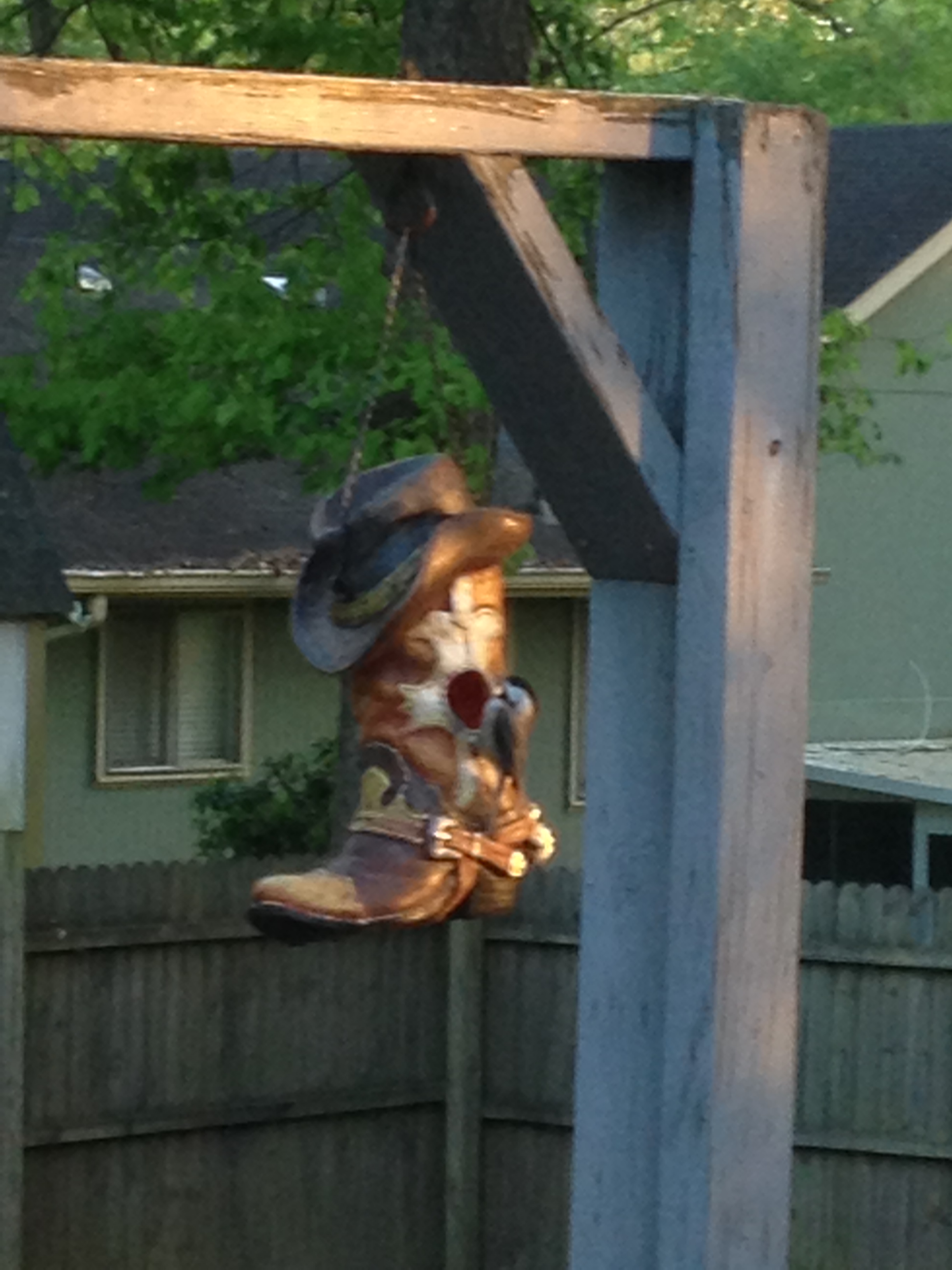
Carolina Chickadede

Our 2015 Carolina Chickadee

Posted in Comedy, Family History, Stories, Uncategorized | Tagged , , , , , | 5 Comments

Check Under the Hood?

When I was a young boy in the 1950s and early 60s we still had full service filling stations (that’s what we called gas stations, in case you didn’t know). And each time someone drove up and parked beside the gas pump the attendant would come out and ask, “Shall I check under the hood?”

If the driver answered in the affirmative the filling station attendant would raise the car’s hood (most cars had hoods that opened from the outside then), check the oil and the radiator along with pumping gas and wiping the windshield. Invariably, he would find that the car needed about a quart of oil, and he was happy to accommodate the driver (and add that to his/her bill).

My father taught me early on not to pay attention to the station attendant’s measurement of the car’s oil, since (he said) it takes about 15 minutes for oil to drain back into a measurable place in the crankcase after the engine has been running for a while. In other words, expect that you will always appear to need some oil if you take the measurement at the wrong time; in truth, if you added oil at that point you would likely be overfilling the crankcase.

We all know the truth of a matter, and how things appear, can be quite different, don’t we?

I was reminded of this today as I arranged to take my Toyota Corolla to a dealership for a safety recall repair. I am seldom pleased when dealing with car dealerships of any kind; I suppose there is good reason for the negative stigma they carry.

The dealership was impressive: well manicured lawns, immaculate buildings, shiny new cars, even glimmering pavement in the service area where you drive in. The signage was absolutely gorgeous, and the uniforms worn by employees colorful and attractive. The opulence was everywhere.

But . . . the service was less . . . much less than first rate. The appointment I had made on the phone seemed to make no difference whatsoever; the person I had been told to ask for was not even at work today, and the schedule did not allow for the service I had been promised. [By the way, I can tell you that they made some changes and finally did accommodate me in the end].

The opulent exterior of the dealership in no way represented the way things actually were once you were “under the hood.”

I was reminded of this same phenomenon early this morning as it was announced on the radio that almost all of the eleven Atlanta Public School officials indicted in a cheating scandal had taken the deal offered them by the prosecution, i.e. to admit guilt, and agree to a $5,000 fine, and community service.

Needless to say, school children were harmed in all this craziness, too. But adequate payment for that loss . . . well . . . can that even be quantified? The teachers and administrators involved in the scandal just wanted student test scores to look good to state and national officials, so they doctored them a bit. The lie looked good on the surface, but underneath, it was what it was – a lie.

I am no doomsayer, but . . . I don’t see our society growing into a better and more loving collection of communities. It could be argued that we exhibit more moral devolution than evolution. Ask yourself how many of our national leaders you trust.

We are no longer even shocked when we hear of scandals involving actors, entertainers, athletes, politicians, academicians, religious leaders, corporations, non-profits, etc. Or even . . . the neighbors down the street.

We have come to expect that there are numberless closets with countless skeletons hanging in them. If we don’t know of any scandal in a given situation, we suspect it is just because it has not yet come to light.

We have become dyed-in-the-wool cynics.

Now you may point out that the gas station attendant in my childhood story was exhibiting some dishonesty as he wiped the dipstick and reinserted it into the crankcase to measure the oil level before it had time to settle. And you would probably be right. [Although, I must add that any attendant worth his salt in those days would allow some margin in his assessment for that very reason; not everyone was dishonest. In addition, he would show the dipstick markings to the customer, and let him/her make the decision.]

Granted, what is truly “under the hood” has been a challenge for human beings since man first walked the earth. Humans migrate toward the shiny exterior; we like to dress up the outside even if the inside is going rotten. It’s in our hard wiring, our DNA (if you will).

That may be one reason why we have embraced the fitness rage in our country. We are enamored of beautiful bodies, and we will do almost anything to . . . .

“Hey! Hey! Hey!” [I’m getting onto myself, because I am really interested in fitness and looking good – even in my old age. Ha!]

I don’t mean to start a war here. I just want to say this: “Look at the way we emphasize the importance of how things APPEAR, as opposed to how they really ARE.”

“Rome wasn’t built in a day,” a 12th century cleric has said. But I would add that it did not fall in a day either. There was a gradual disintegration.

It crumbled from the inside.

When the inside of something is rotten; that is, when the outside of a thing is not representative of what is truly on the inside . . . there will come a moment when the truth emerges out of the subterfuge. I have seen it happen in my own life, and have witnessed it in countless others.

So, what is truly “under the hood” in our society? Shall we check? If so, we must do so one person at a time.

The answer will be found in your own heart.

Here is the procedure:

  • Sit quietly (for at least 15 minutes; to allow your inner oils to drain into the crankcase)
  • Use an accurate dipstick (one you’ve wiped clean of past stains)
  • Add adequate SAE approved lubricant as needed

Let’s make sure we spend at least as much time making our insides look good as we do making our outsides look good.

Posted in Family History, Stories, Uncategorized | Tagged , , , , , , , , , , , , , | 10 Comments

Finish Line

We celebrated Easter yesterday!

We not only had beautiful flowers in the house and in the yard, but we hid brightly colored plastic eggs (candy filled) for the grandchildren to find, entertained guests for a late lunch (egg casserole, bacon, fried potatoes, biscuits, fresh fruit salad, and a variety of muffins and cakes etc.), and had pleasant conversation with family and friends while the kids played outdoors.

Thankfully, we ate that sleep-inducing food after attending church (trying to stay awake in any public gathering subsequent to that meal would have been impossible), where we celebrated the resurrection with hundreds of others in our brand new church location.

As my readers know, I am cautious about using this blog to promote or discuss religious beliefs (I have another blog where I present those kinds of thoughts, http://www.thegodstory.wordpress.com), and so I am not writing today with any agenda of that sort in mind.

Nevertheless, the season of Spring, the gorgeous Easter Sunday following the blood moon, the television shows discussing Jesus, the brightly colored candy and decorations in stores, as well as the sixth anniversary of my father’s death (on April 9) . . . have gotten me to thinking about the one aspect of all our life stories that is seldom discussed.

The End.

Or . . . as I was thinking of it, today . . . the Finish Line.

Everyone will experience it: believers and unbelievers, Christians, Muslims, Jews, Buddhists, Hindus, etc. There is an end for us all, a finish line (if you will) that we must cross. It matters not whether you see this line as just a transition to another state of being, or whether you see it as a true END of existence in any form. Either way, it is a line we must all cross.

And for all parties concerned, those with a professed faith, and those without any professed faith, that line is drawn at the same place: death.

A friend of mine lost her husband of 40 years last week; he was 73 years old. We attended his funeral, offered what comfort we could, then went on with our lives – only, we were slightly more aware of the fact that we, too, would one day be crossing the same line he had crossed. For him, it was no longer just a concept; rather, an experience.

Much is made of the final words of Jesus as he hung on the cross: “It is finished.”

Theologians, of course, have provided various interpretations of his intent in those final words. What exactly was finished? His life? His mission? His agony? His ________?

The truth is, we will all say, “It is finished.” We may not say the words, because we may not be able to do so. But we will all say it with our passing; we will all finish.

What concerns me is not whether or not I’ll finish; rather, how well I will finish.

I was never a very fast runner. But decades ago, when I used to run regularly, my friends and I trained to run the Marine Corps Marathon in Washington, DC. We had run some 5K and 10K races, and had run from East Memphis all the way down Poplar Avenue to the Mississippi River in Downtown Memphis, timing our run so we could arrive downtown just in time to run in a 15K Oktoberfest race, all in preparation for the coming marathon.

Clearly . . . I was much younger then.

I will never forget the excitement (and the pain) as I crossed the finish line at the Marine Corps Marathon in Washington, DC in November 1983. The Marine Corps band was playing “When the Caissons Go Rolling Along” at that poignant moment, just over 4 hours after an 80mm howitzer had signaled the start of the race.

I go back to that memory whenever I experience hard times, and I recall the pain I felt, the prescribed Butazolidine (race horse medicine, now illegal) not quite equal to the task of taking away the pain caused by my tendon as it struck an inflamed bursa sac with each and every step.

But – I finished. And it was glorious!

And what of your life’s 26.2 miles? The marathon you are in?

For we are all in a race of sorts, are we not? Our purpose. Our intention. Our mission. Our agony.

As human beings we share this together. This human . . . race, we sometimes call it. Will you finish well?

I watched my father finish his race 6 years ago. Then I watched my mother cross her finish line 2 1/2 years ago. They finished well. Brave, resigned, lucid, and prepared . . . they embraced their “ending” with aplomb. I have watched as close friends have broken the tape at their respective finish lines, and passed to the other side; it is awesome to witness the end of a life lived well.

Sometimes it is as if the musical score of our lives gives us a chance to repeat an important musical phrase when it instructs us as follows: D.S. al fine, i.e. go back to the Sign, then proceed to the End.

But proceed to the End we must. Eventually, we all cross that line.

The message of Easter, of course, is that endings can be deceiving, that finish lines are sometimes starting lines in disguise, that there is a fine line between graduation and commencement.

Just my musings. I know.

But I do think about these things a great deal now. And when my own race ends . . . and I cross my finish line . . . I hope to raise my hands high above my head, press my chest against the tape, and burst into whatever awaits me on the other side.

I expect there to be a crowd cheering. And I expect to hear a band playing my favorite military song about the caissons. You see, fifteen years ago I received my instructions: D.S. al fine. I went back to the Sign, and repeated the phrase. Now I am bound for my finish line.

With aplomb.

Posted in Family History, Stories, Uncategorized | Tagged , , , , , , , , , , , , , , , , , , | 3 Comments

The Ring

Fifteen years ago my marriage was in a shambles. I had done 24 years of damage to our relationship and, as Malcolm X said regarding JFK’s assassination, “the chickens” had “finally come home to roost.”

We were at a breaking point, several events serving as the final catalysts of our destruction; we were headed for divorce.

We had just celebrated our 24th anniversary when some secret damning information came to light; the demise of our relationship was on the horizon, and I started to plan the way I would explain our separation to friends.

I won’t bore you with the sordid details, but suffice it to say I gained some valuable insights in the ensuing weeks; these came from conversations with friends (both past and present) as well as strangers in a support group I had joined. The crumbling marriage held together somehow, and we began to make slow progress toward restitution.

In my support group I was given literature to read, and in the process of reading I came across a phrase that stopped me in my tracks. It was “commitment of permanency.” When I read the phrase I realized it was something I had never had in my marriage. I did not even know how to be fully committed, fully invested, totally involved in any relationship.

As I began to learn more about myself, and face the deleterious behaviors I had embraced, I realized that “commitment of permanency” was a quality I aspired to possess, and I set my mind and heart to the task.

My wife had given me back her wedding band in disgust. So . . . unbeknownst to her, I carried it in my front right pants pocket each day; it rested inside the circle of my own wedding band (which I had removed as well), symbolically encompassed by my protection, my love, my new commitment.

Symbols are interesting things. Clearly, they are not the substance which they represent,  and they can be as hollow as empty words. On the other hand . . . they can be as powerful as a battle flag that rallies the troops, or a shiny badge that carries with it the whole vested authority of a sovereign nation.

I took my chosen symbol seriously. I carried those two rings, one encircling the other, for many weeks. Because for me, it was significant that I learn how to shield, guard, prize, cherish, and encompass my chosen bride. I was reminded of the framed counted cross stitch we had been given at our wedding; it read,

“Choose Thy Love. Love Thy Choice.”

I could not afford a diamond engagement ring when we were planning to be married (39 years ago now), and as the years passed it seemed a needless expense. But a decade and one-half ago I made that a new priority. I picked out a diamond ring, surreptitiously paid on it for six months, then planned the special way I would present it on our 25th anniversary in Charleston, SC.

After we recited our marriage vows to one another, we exchanged rings (except that I had secretly replaced her wedding band with the new diamond ring for this occasion). It served to mark an anniversary that would not have happened at all had I not honored the new reality those rings symbolized in my heart.

Our relationship has steadily improved since those days. Now we are true partners. Not perfect, mind you. But best of friends, nonetheless.

And it all began . . . with a ring.

I was just reminded of all this today as I listened to Craig Groeschel talk about the book, “From This Day Forward.”

And I was prompted to write this brief synopsis of my experience with rings, because – in a very real sense, by all accounts, our story should have ended 15 years ago.

But it did not.

A large ring surrounded a smaller ring. And in that nested place of refuge a new relationship was born. The never ending circle of the ring tells the tale, and symbolizes the beauty that can be found – in the refusal to ever give up.

Posted in Family History, Stories, Uncategorized | Tagged , , , , , , , , , , , , , , , , | 8 Comments