Last night was eventful for us; the cold weather blessed us with a house guest of small stature. He was not invited (mind you), but I noticed a small dark object race down beside the baseboard of one of our rooms and I went to investigate. A large roach? A lizard? Something else?
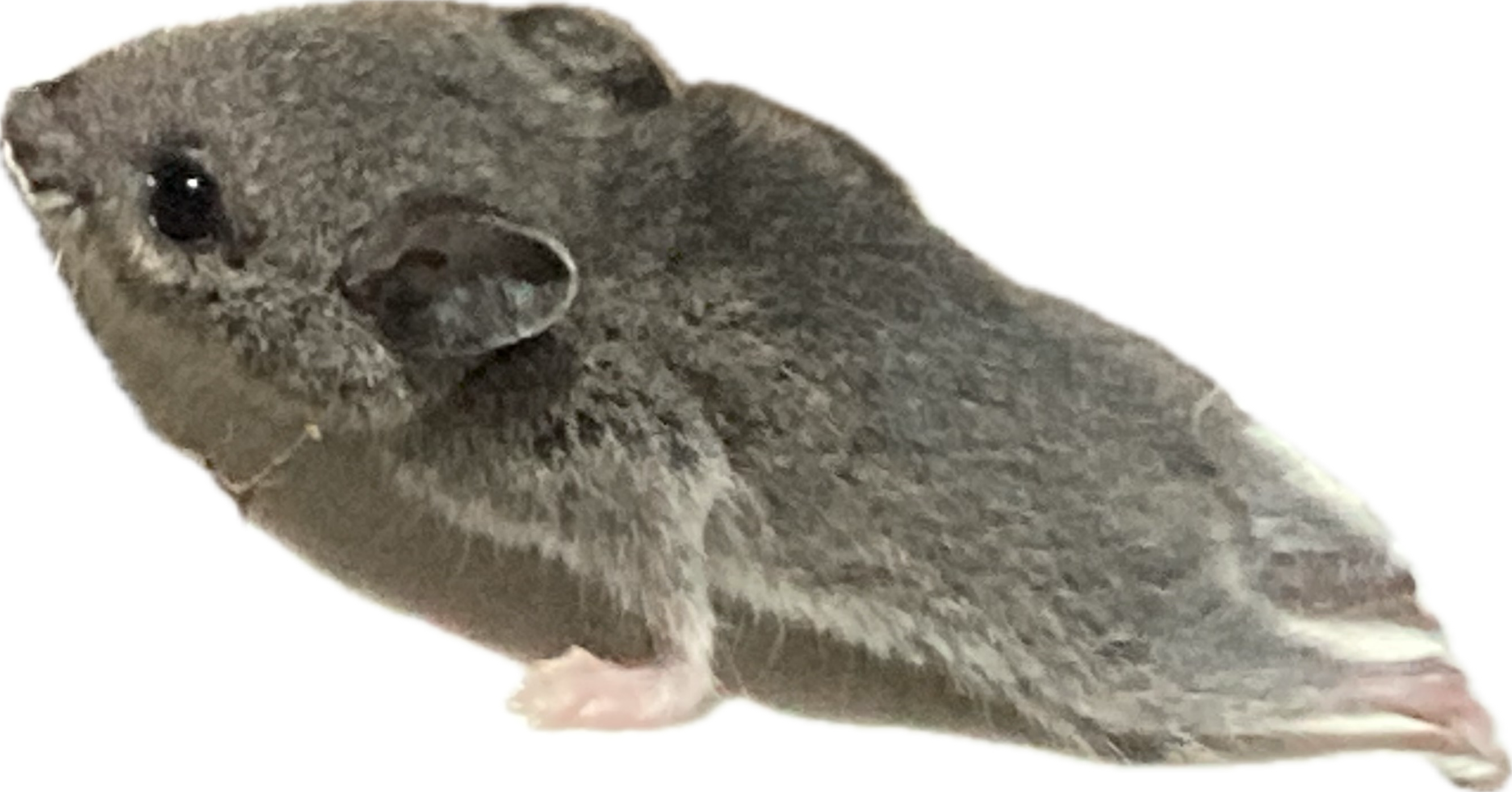
Another movement by our guest (intended to give him/her greater cover) exposed his tiny identity more clearly: a small grey mouse. To prove his racing prowess he darted across the middle of the floor right by my feet then tucked himself in the corner under a desk. The beam from my iPhone light revealed his small, quaking frame.
My youngest daughter, and my wife and I, quickly went into action, Googling, discussing, and commiserating about the best way to handle our speed demon visitor. This was not our proverbial “first rodeo” but, then again, none of our previous rodeos lasted a mere 8 seconds, and the cheering crowd at the successful conclusion of our “rides” was small (to say the least).
Orkin sticky traps were employed, initially to no avail. An old traditional wooden mouse trap was resurrected from the garage, loaded with aged Vermont white cheddar was placed along the wall. Then we exited, awaiting the deadly SNAP that would spell our success.
“But Mouse, you are not alone, in proving foresight may be vain: the best laid schemes of mice and men go often askew, and leaves us nothing but grief and pain, for promised joy!” (Excerpt from “To A Mouse” by Robert Burns)
But no snap was heard. And after checking on several occasions I feared our unwelcome guest had outwitted us. Either that or . . . like me he was the one mouse in a thousand who hated cheese, one offended by such rodent sterotypes. Then my daughter noticed that one of our sticky traps had been relocated. Hmmm. Upon further examination we found that the repositioned trap had done its work: the tiny creature was indeed stuck.
A cardboard box was procured, Special Forces tactics were employed (if we shared these “we would have to kill you,” as they say) and voila: the capture was complete. We took our small friend outside and were immediately eyed by a neighbor’s cat.
Robert Burns added this: “Now you are turned out, for all your trouble, without house or holding, to endure the winter’s sleety dribble, and hoar-frost cold.” He failed to mention the neighbor’s cat, but . . . poets can’t cover ALL eventualities.
Burns concludes: “Still you are blest, compared with me! The present only touches you: But oh! I backward cast my eye, on prospects dreary! And forward, though I cannot see, I guess and fear!”
Profound. And true, of course; in 1785 when penned as well as now. But hopefully it doesn’t depict the whole truth. We all have our bouts with fear and uncertainty and dreariness. But unlike our tiny friend and our extraction of him from our house, the rodeo we call “Life” is a ride like no other: one that involves pain and disappointment . . . but also one that brings joy and love and fullness.
When we cornered the small mouse (at one point behind a plastic box fan), I watched as his tiny ears cocked this way and that as I tapped on the wall, and as we spoke regarding our strategy. May we, too, be always aware of our surroundings, directing our ears to detect the sounds of our lives, ever alert to the movements of those around us, and remembering to “live” each moment.
”The best laid schemes” and plans of our lives WILL change; of that there is little doubt. But we need not dread, we need not cower in fear, we need not tremble in the face of changes. Rather, we choose to LIVE!
Sounds like a verse from wisdom literature, doesn’t it? Or the Bible. One thing’s for certain: it’s current!
A few hours ago I caught parts of an NPR discussion about alcoholism, its causes and cures, and how well the “scientific” approach to recovery works. It was informative . . . and disturbing.
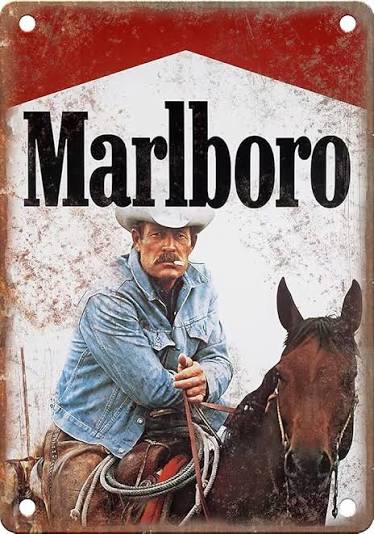
I am so over the plethora of drug advertisements on TV these days; it seems like they have replaced the old network alcohol and smoking ads of yesteryear; you know, the ones we decided were harmful for kids. No more Marlboro Man! And no more catchy jingles like “Head for the mountains . . . .”
Today we are inundated with drug cures for diseases and maladies I never even heard of growing up. And the list of possible side effects (in tiny print) is daunting. The actors in the ads seem just fine though.
When Bill W started AA back in the 1930s he did so positing that it was “one drunk helping another drunk to stay sober.” In short, it was dependent on relationships. Yes, God (the “Higher Power”) was part and parcel, but back in those days that was not anathema. For the godless age we drunks decided we needed an alternate savior: let’s hear it for SCIENCE! (Courteous clapping)
In the 1990s a drug to cure alcoholism was developed; it was called naltrexone. There are other drugs used currently, but this one was highlighted on NPR today. All these medicines are intended to curtail the desire for alcohol, much like the numerous weight loss drugs in vogue.
I found it intriguing as I listened to a young author (herself a recovering alcoholic) explaining how AA and it’s “spiritual” component is fine for some but not necessary for others. For she, herself, began drinking at a very young age and became addicted without any deep seated spiritual issues. I wanted to ask, “Says who?”
All 12 Step groups state that if someone can get sober another way apart from 12 Steps . . . “more power to them” (so to speak). But to assert that someone with an addiction has “no spiritual issues” only works if you don’t accept that everyone is a spiritual being. In fact, I’ve never met ANYONE that doesn’t have spiritual issues, addicted or not. The young author on the radio is no exception . . . whether she sees it or not.
The author said that AA is fine for some, but she said asserting the spiritual component as a cause for EVERYONE’s addiction is “pernicious.” Ouch!
Pernicious? Really? Destructive? WHAT?
Our society is overrun with drugs; drugs are the solution to everything. Relationships? Well, they come and go. Higher Power? Well, that’s not real popular right now; in fact, some consider it intrusive. So, we say, “ you do you!”
But drugs? Ah yes. The impersonal, accepting, non-judgmental solution to all our problems. Because with drugs . . . all things are possible. Go ahead and bring on AI for counseling, too.
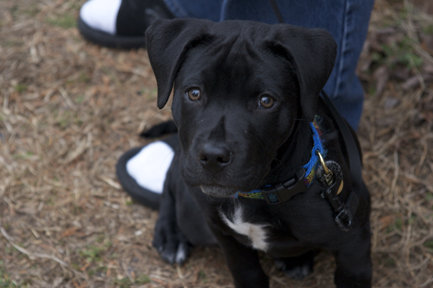
He and his two sisters were just a few weeks old when they were found in an abandoned warehouse. We chose the boy; my eldest daughter took his two sisters. I wasn’t eager to engage in this new venture; I had just put down our beloved shepherd/lab mix, Marshmallow, a six-year-old with Addison’s disease just a couple of weeks prior, and we were still grieving. But this dog’s eyes followed our every move and locked with ours as if to say, “I will faithfully follow you to the ends of the earth . . . if you’ll have me!” We had no choice but to choose him.
(Of course, we might have misunderstood. He could have been saying, “You people are MINE now!” Who knows?) So, we named him Lex Oliver (after Lex Luthor and Oliver Queen, the “Green Arrow” since we were watching Smallville at the time). I was uncertain whether his part-Pitt pedigree would prove dangerous, but the Lab part of him soon made it clear there was nothing to fear.
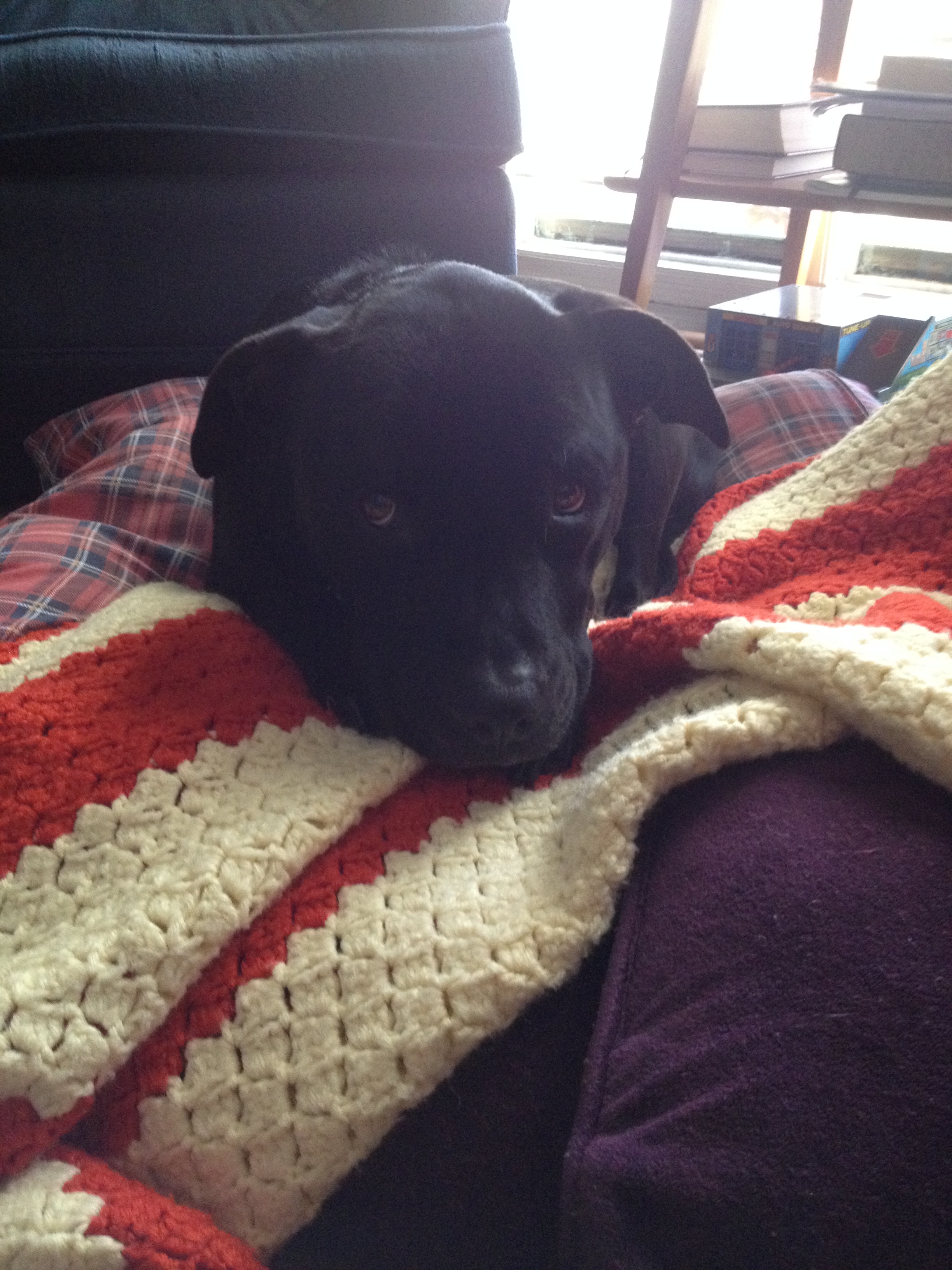
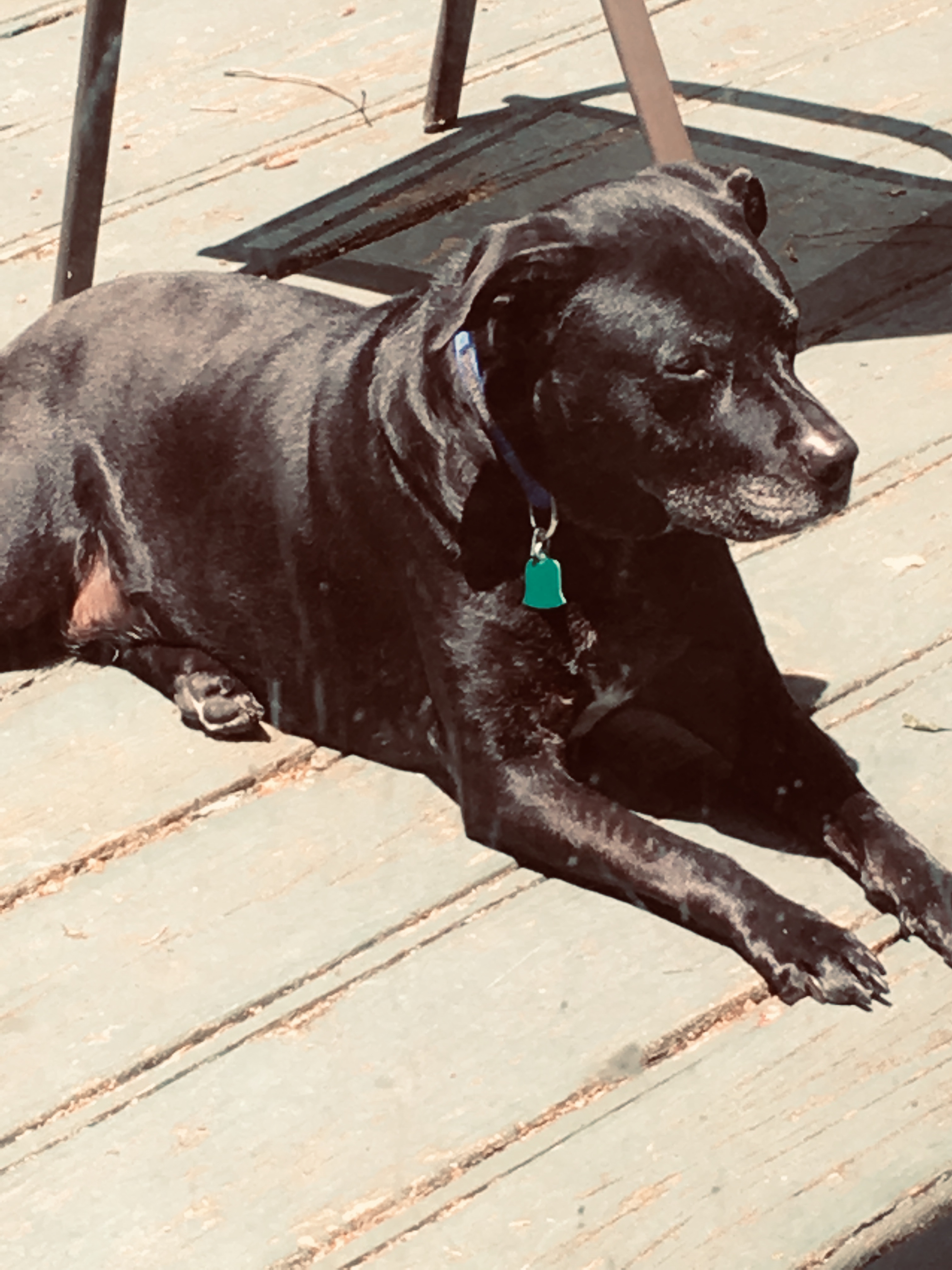
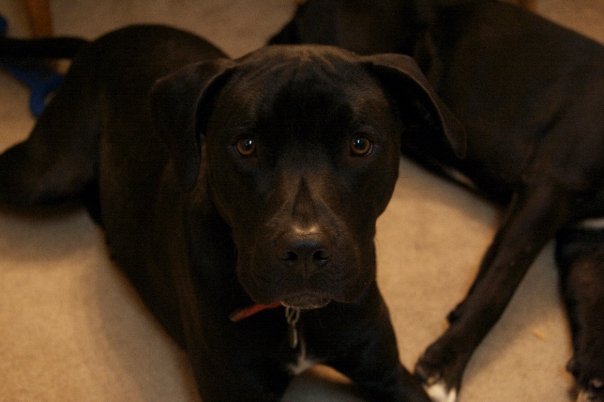
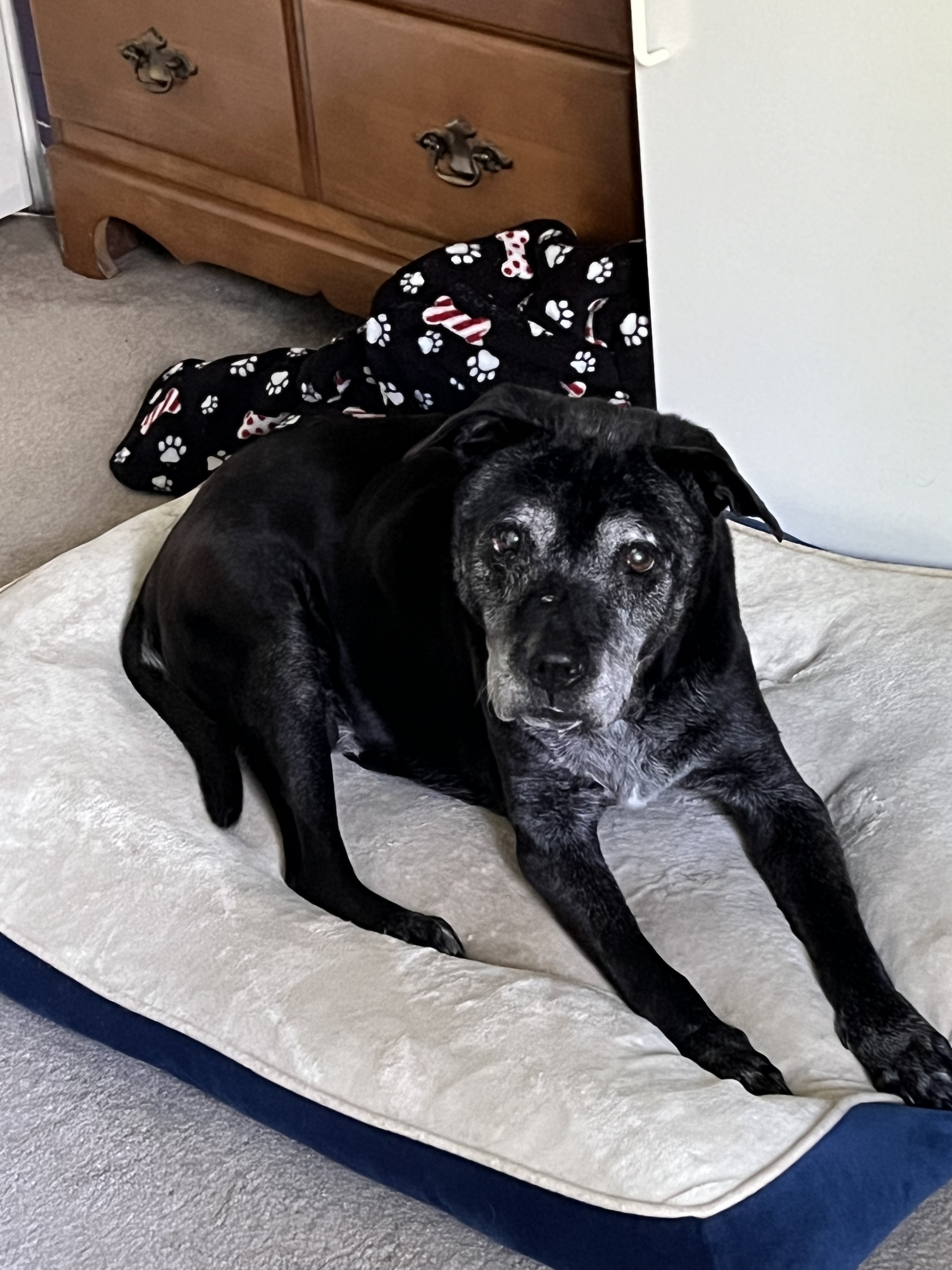
He was nothing short of handsome in his beautiful black coat (I called it his tuxedo) with a couple of white accents, square Pitt Bull jaw, and engaging brown eyes. It wasn’t long before he had worked his way into our hearts. He is there still.
Weeks turned into months, months to years, and almost inexplicably our furry pet was two months from turning 18, and, practically speaking, as much a part of the family as we were.
In that length of time (especially for an indoor dog like Lex – which, of course, I called “our air conditioned dog”) our pet had shared in our physical and emotional struggles just as we shared in his. After all, in dog years he was about 125 years old, right? He was present for my heart attack 9 years ago, barking protectively, shut up in a bedroom as firemen entered our house in the wee hours and carried me out to the ambulance. He laid beside me in my recovery very much aware of the seriousness of the time. He was present in the years we lost one parent after another, spanning the years from 2009 to 2021.
Lex was present for the arrival of each of our four grandchildren. And yes, he was with us on the day our family mourned the loss of Ewan, my eldest daughter’s stillborn child. Every Christmas my youngest daughter decorated Lex with lights, and every Thanksgiving he celebrated with us by looking for fallen crumbs off the dining table.
He was present as my wife began to struggle with major health issues. And he witnessed my youngest daughter’s bout with panic attacks. But his own physical struggles were in the family mix, too: being viciously attacked by a neighbor’s dog (that injured his eye), numerous tumors, an irreparable CCL in one back leg, and various maladies (and cones-of-shame) through the years. We began fearing we would lose him YEARS ago, but at each annual visit with the Vet his blood work was impeccable; his heart and strength of spirit were indomitable; I said, humorously, that he might outlive us all and be found grieving beside our graves.
And truthfully . . . that might actually have proven true had we not had to make the decision to have him put down on Sept. 4, 2025.
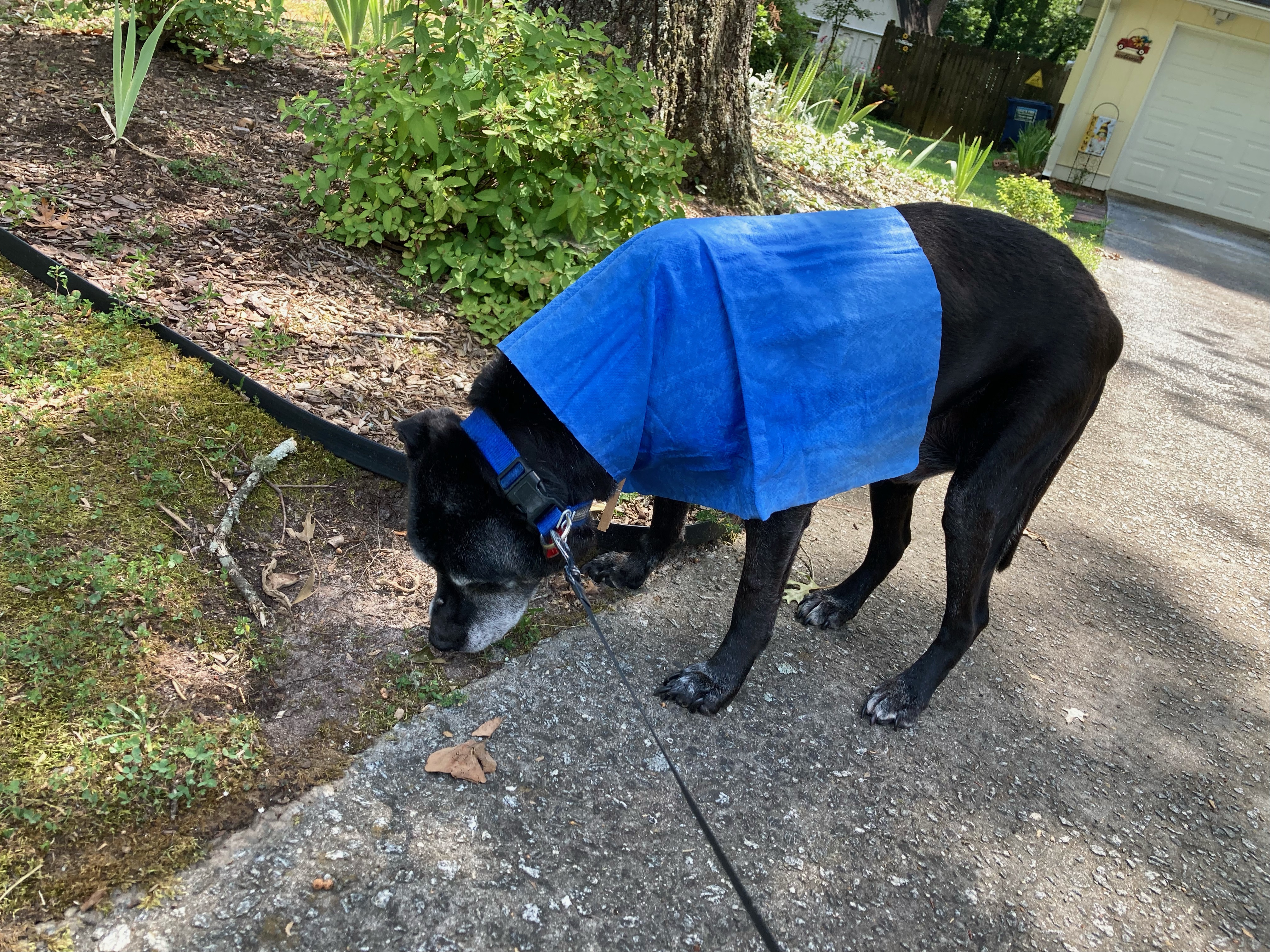
Our daily afternoon walks (which he entered the room and announced without fail) began to diminish in duration as his back left leg began to fail him, and a couple of instances of overheating made us adorn him with “the blue cape,” a cool water-retaining rag held on with a clothes pin when we walked in the warmer months. A few months ago the walks ended altogether, and we would let him out in the front yard to “do his business” and to do what I finally realized was “grass watching” (the way some people “bird watch”). His inability to handle steps had long before stopped his going down off the back deck into the backyard. Eventually he completely stopped going out on the back deck at all.
His world got smaller. He slept most of the day in his luxury bed in our back bedroom. He compensated for his failing eyesight with a nose that could detect rotisserie chicken still in the plastic bag on grocery day . . . all the way from the back of the house. He began to hate loud noises, or even conversation near him, and in his final year or two was afraid of thunder. He became a recluse. He would still come out to sniff and greet newcomers, but not in the way he used to, and not for any measurable duration; his cushioned bed was his castle.
In his younger days he had been a lover of bluegrass and country music and would lay in the middle of the floor amongst our instrument cases when we practiced; he was never critical of our performance but seemed to really enjoy it. But in his latter years music no longer enthralled him.
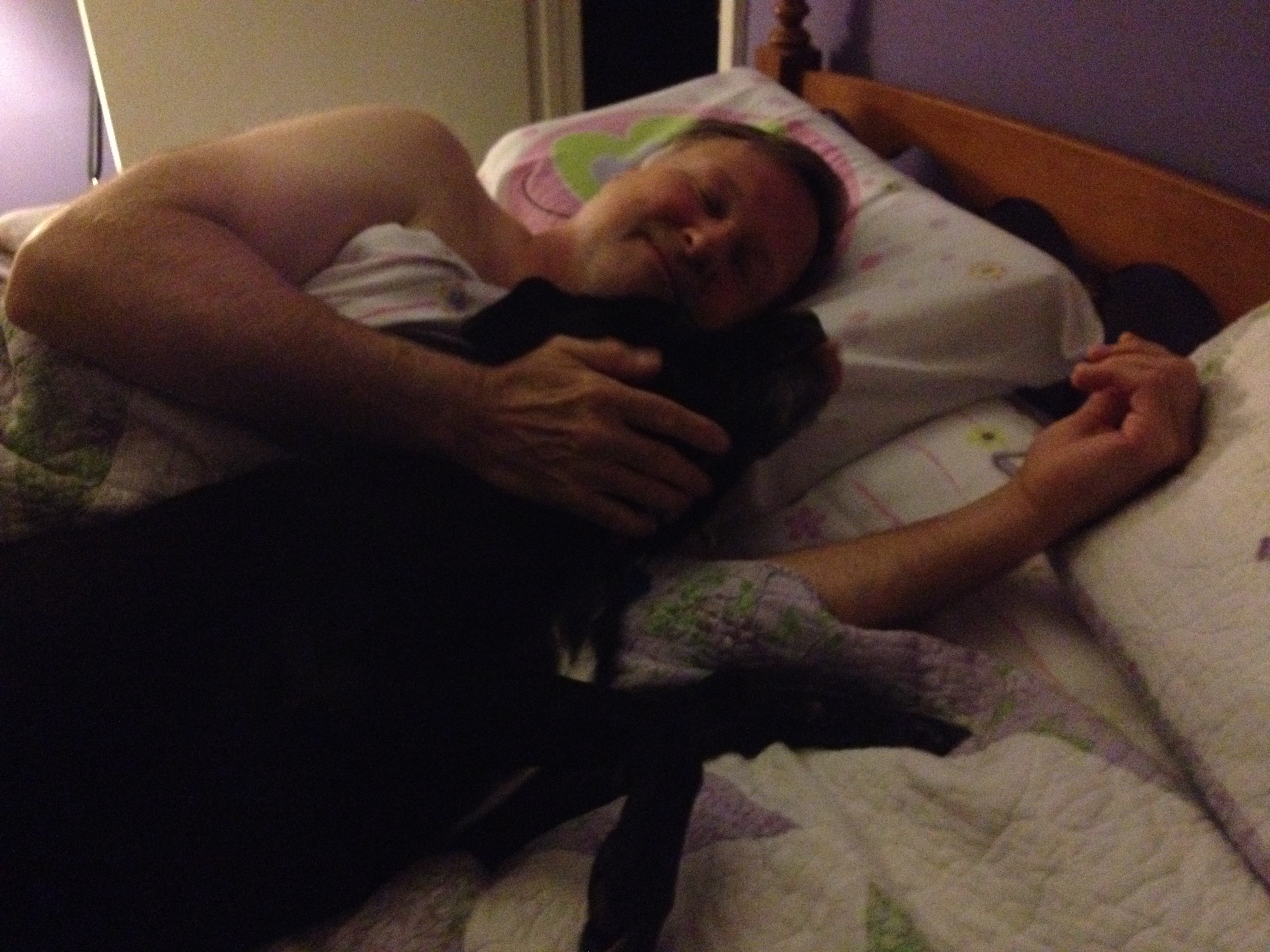
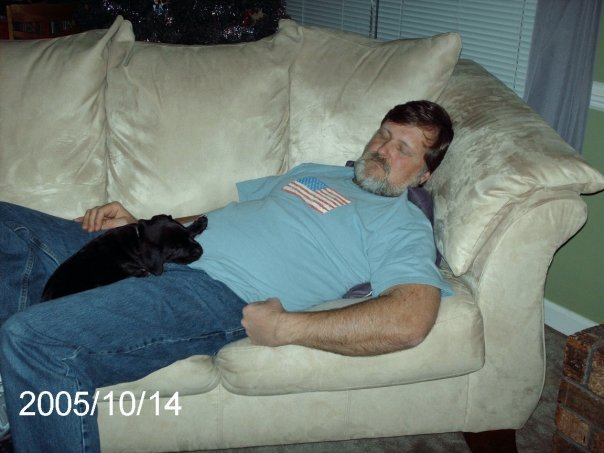
After my heart attack, when I returned to part-time work, our work hours allowed me to come home for lunch and nap during a three hour break; Lex would join me every time.
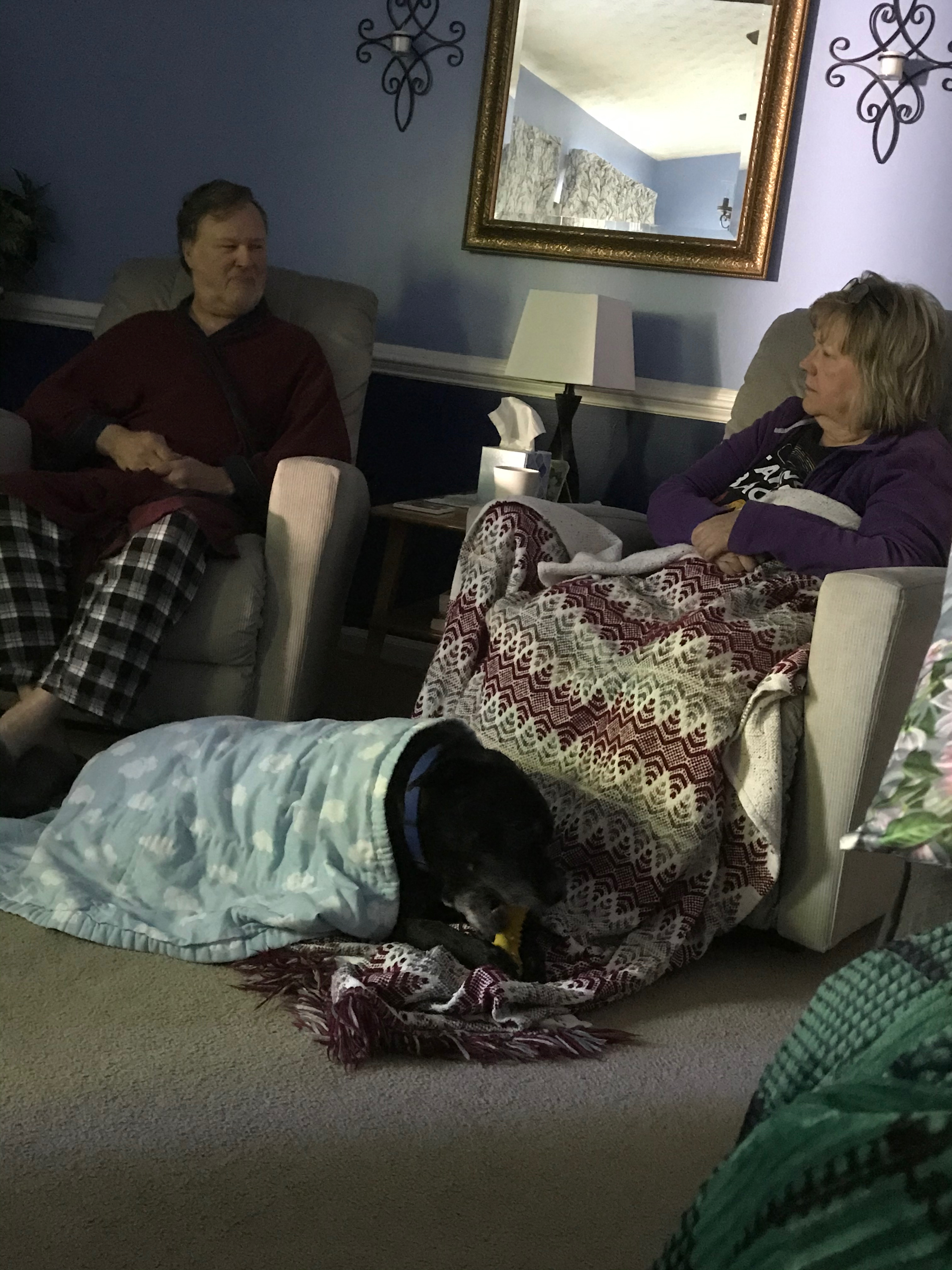
If he could find a good blanket to wrap himself up in . . . he would, especially if it was at his Mommy’s feet! And a good chew toy (that we called “Spikey”) never hurt anyone! “Go find Spikey,” we would say! And off he would go to search.
Lex had a bark that sounded twice the size of his 60-65 pound body; he was a bass-baritone who would bellow so hard his front legs would lift up off the ground. And we called him by so many names: Lex, Lex Oliver (if he was in trouble with our daughter), Lexycorn, Goobie, Buddy, Junk Yark Dog, Corndog, Boogie, Muskrat, Baby Legs and 25 other epithets.
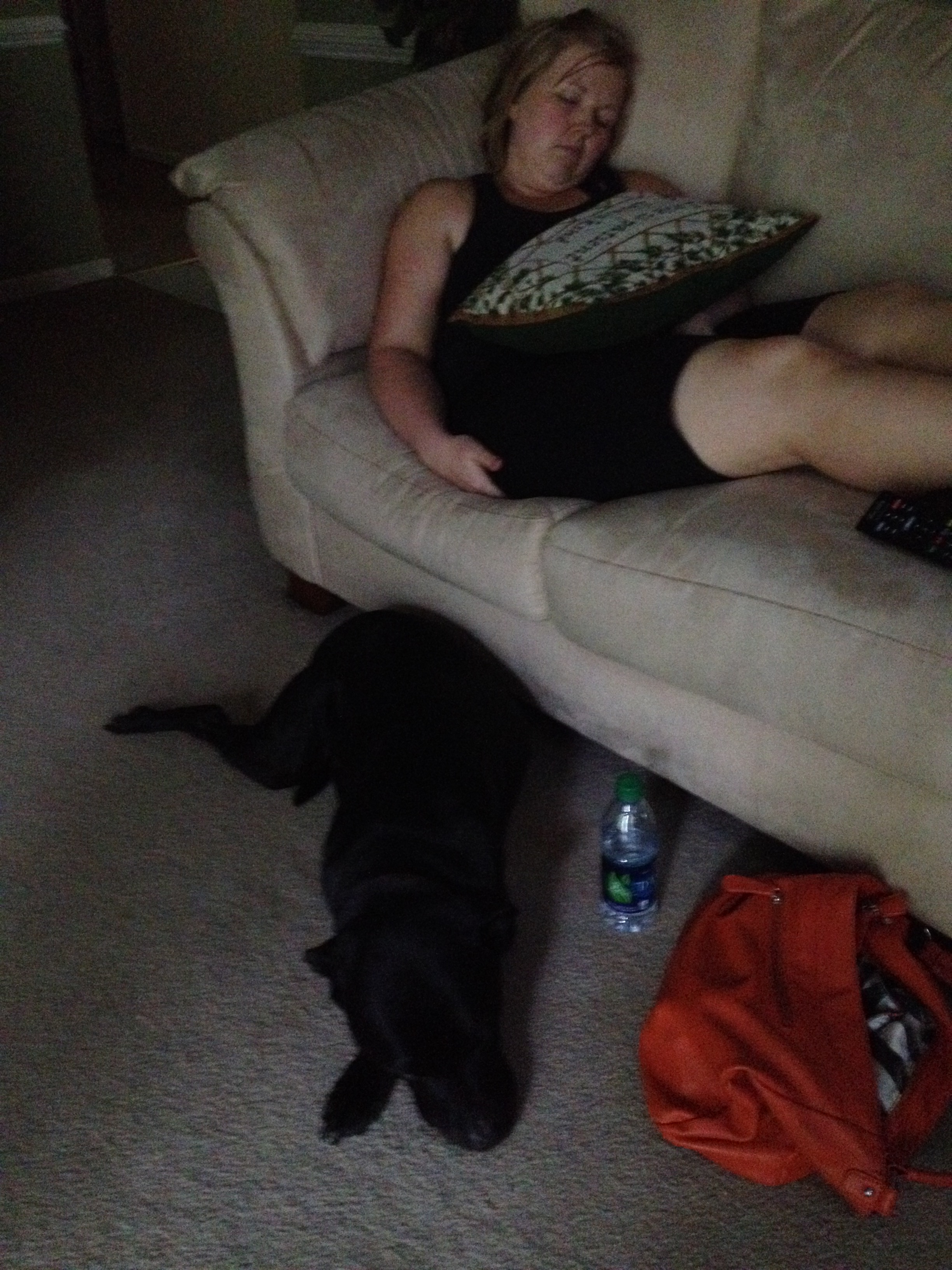
Lex was always ready to join family members in a nap.
His squirrel and cat chasing diminished after his leg injury, and the animals nearby soon came to realize they were in little to no danger near him; they were no longer a priority to him. Like the rest of us who are aging . . . he began to slow down.
In his first years with us he and his sisters (they would come to visit) would wrestle and play in the backyard . . . well, until there would be a fight, that is. Lex was so obsessed with his sisters and got so excited when they would visit. All we would have to say are the words “the girls are here” and he would go crazy and race to the front windows with anticipation. Invariably he would bother them until a defensive growl and snarl from one of them would end the fun. Sometimes we would have to separate them (some inside, some outside), but eventually all would come in, lie down, and sleep on the floor.
I have often wondered how these creatures, descended from wolves, are able to capture our hearts. I am sure their total dependence on us for food and care is a part of it, but . . . there has to be more. If you look into their eyes something almost magical happens; there must be a love vortex that sucks you inward until you actually see them as almost human. We used to joke about Lex, saying, “Great dog . . . horrible person!”
There were, however, certain things Lex didnotlike at all. And as he got older it became abundantly clear that one of those things was bath time. As a tiny pup he had little choice but to endure it, but as an adult (especially an aging one) he made it clear that he would just as soon avoid it if at all possible.
When the vet suggested the drug librela to control his osteoarthritis pain (in addition to the galliprant we were already giving him) in January 2025 we jumped at the chance to prolong his rapidly diminishing mobility. And it did seem to help a great deal for the next 8 months. Truthfully, though, it would take him a couple of days to become himself again; the trauma of the visits took their toll. But as he reached the date for his 9th shot his disability was markedly worse, and finally, not able to stand on his own except for brief moments, he would collapse. In his eyes I could see the terror, the frightened and alarmed look of a defenseless and vulnerable animal; our help lifting him would not allay his fears.
We had discussed this moment with the vet months before; she had assured us that he was a candidate for euthanasia at any point we decided was time. His look that day transmitted to us, in no uncertain terms, that it was that time. All that night and the next day until his 4:00 PM appointment we began the process of preparing to grieve. His last day on earth he had no inclination to come to his food bowl, even though I had bought rotisserie chicken; I took several pieces back to his bed and he ate them. He also drank a small amount of water, but we had to take that to him, too. He just didn’t trust himself to stand and walk.
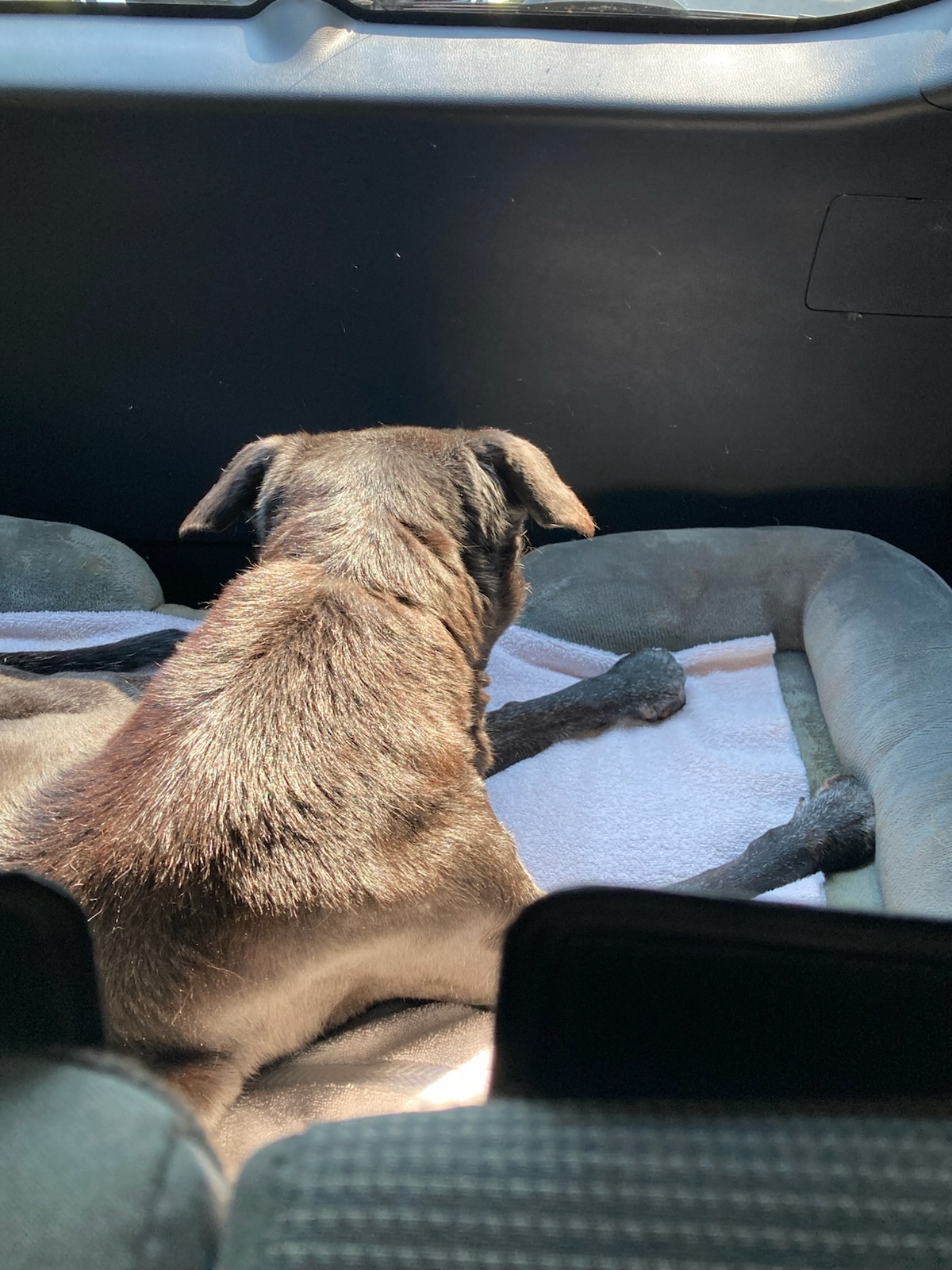
The clock moved ever so slowly that day for us all . . . until the last hour; at that point it seemed to speed up tremendously. We took him out to the car, placed him on his bed in the back and drove to the vet minutes away. The sunlight on his final car ride was like a glowing blanket engulfing him. Once we were inside we stroked his hair gently, and watched as he was given a fast acting sedative with ketamine to calm him, then he was given the slow fatal dose of pentobarbital. The goneness was palpable. But he died in peace . . . in his own bed.
A young, energetic, bigger-than-life animal had endured the pains of a long life, developed his own unique side-winding way to walk in order to compensate for his injured leg, grown grey hairs with age, lost some canines with time, and lost the ability to see clearly. Yet . . . was a faithful friend till the end.
I could tell more stories but that would prove endless:
the 10 minute delayed howl (in his old age) after being rushed upon by a young neighbor dog
deciding to take himself for a walk one day
journeying around from the backyard to patiently waiting at the front door because someone forgot to close the gate
his relationship with the Orkin men that came every two months
his off-the-charts love for our neighbor, Pat, (and her backup, Paula) who graciously watched over him through the years when we had to travel
his unique sniff or snort after just waking up
his careful examination of the small statue identical to him that sat on our back deck
the rising pitch of his farts (he had his own unique melody)
the way the wind outside would excite him (in his younger years) and cause him to run around in a craze
his “reset button” (as my daughter called it) when he would eat a bit of dinner then come out for a treat (or “num” we called it), then go back for more dinner, then come for a treat again . . . ad infinitum
His love for canned pumpkin and green beans combined with his dry dog food
the sound of his nails on the tile entry way announcing his desire to go outside to potty
“Goodbye, dear Lex. Thank you for the years, for the love, for the humor, for the protection, for the faithful dedication to your adopted family. You were . . . and are still . . . an extravagant giftfrom God.”
Now run with the wind! Speed around heaven with the total abandon you had in your youth. Your impediments are gone, the physical chains that restricted your movement are vanquished. You are free!
Maybe I’m not all that different from you. Or maybe I am. But most people I know are controlled (or at least highly influenced) by one or more childhood experiences. I was recently reminded of some of mine in a counseling session a few days ago.
Insights often come with pain. My own ruling triumvirate was comprised of three words: stupid, fat, and ugly. These have stayed with me throughout my life, and they have prompted me to avoid their appearance at any cost. To be seen as stupid, fat, or ugly is very shameful to me. And so I strived all my life to keep these three at bay (with varying levels of success), yet similtaneously feeling they were an accurate description.
We tend to overcompensate for our weaknesses. So, for me, to be uninformed in an area I have investigated is a grave situation. Therefore I have a desperate need to UNDERSTAND things fully; to be caught in an error, or a weak conclusion would be a confirmation of my stupidity. “You didn’t think this through, did you?”
Trouble is, NO ONE can avoid blind spots. But to divest the emotion of shame that comes with a failure in knowledge . . . is a Herculian task.
To be found physically weak has haunted me for decades. When I was a young boy my father used to feel my arms and say, “You’re hard!” This was a great compliment, because it helped to counter the fear I had of being fat. But when I look back at photos of me as a teenager (without my shirt on, no less) I can’t imagine how I ever thought I was fat. As an adult there was a point around 35 years ago when I was closing in on 200 lbs., and photos at that time reveal a protruding stomach. I was so ashamed.
So, I made it a point to be at the gym on a regular basis. And when I received the occasional compliment from the younger guys . . . that really felt good. In fact, after my father’s death in 2009, we moved my mother here near us and I would get her groceries, take her to appointments, etc. but I had very little time to just sit and chat with her like she desperately wanted. Why? Because I had to get to the gym. She passed in 2012 and at that point I would have given anything to have missed a workout in order to visit her.
I couldn’t do much about the ugly . . . “it is what it is.” But oddly, I do recall the comment of the wife of my first employer (I was a teenager); I overheard her speaking about me to someone. She said, “He’s just plain good looking.” I was surprised. Pleased, yes. But very surprised. Me? Good looking? Not ugly?
As I have brought this triumvirate into my marriage and family I have to pity what my wife of 49 years has put up with: a perfectionist whose insatiable self-esteem must be regularly fed with knowledge, exercise, and looking good. I have been a tough nut to crack.
My near death heart attack in 2016 began to put the triumvirate in perspective: no more strength training or running; your age has taken any good looks you may have had; your mind has trouble holding information and figuring out anything complex. So . . . WHO ARE YOU NOW? That’s a question I’ve been answering for almost 9 years now. And you know WHAT? It’s about time!
There was a triumvirate in the Roman Republic, (several over time, in fact); that is, a collection of three strong leaders who ruled over the people. At one point Julius Caesar, Pompey, and Cassus filled these positions. But ultimately the triumvirate system was dissolved and replaced by a single leader, Augustus, ushering in what we know as the Roman Empire.
Maybe it’s time for me to be ruled by a single leader, too, one who claims to be Divine. The triumvirate must GO!
They’re not usually the words you want to hear when you’re flying in an airplane (“We’re losing altitude”), because more often than not they spell impending disaster. They say these words in movies moments before the inevitable crash unless the pilot miraculously pulls the plane out of its dive and catastrophe is averted.
And I had a moment like that recently when my two oldest grandchildren spent the night at our house. They are both already tall, and growing like weeds, so one of my daughters thought it would be good to update their heights marked in pencil on the door jam to our washer room. The results were striking.
My own adult height was established many years ago, of course, and like most people I know I have continued to quote those numbers throughout my life; doctor visits, motor vehicle registrations and any other entity asking for my height has gotten the same info. Of course, I’ve never bothered to check it again for any recent changes. After all, once you are grown you don’t anticipate getting taller; instead, your focus is usually on weight. And then . . . no one expects to get shorter . . . at least not until they’re very old and feeble.
So when my daughter asked to measure my height and compare it to the grandkids I had no objection; I was confident in my height. The results, however, were quite telling: what had for decades been 69 inches was now reading just under 67 1/2 inches. What?
Now 5’9” is not considered tall, of course (my Dad and brother both exceeded that by far), but anything shorter than that is . . . well, . . . SHORT. And now, at 71 years old, that was ME! I had shrunk. Yikes!
That’s when I realized – I am losing altitude. Is a crash impending? Well, of course it is in one sense; each of us will cross that proverbial River eventually. But does it have to be a crash? A disaster? Impending doom?
As I pondered this change in my height, and considered the numerous other changes in my body and in my mind in recent years, I was forced to look more closely at the airplane metaphor that haunted me. Because, of course, each and every plane that lands safely loses altitude, too. The loss of altitude doesn’t always precede a crash; more often than not the landing is smooth, over and over again.
This life you and I are living is comprised of gains and losses, heights and low places, light and darkness, mountain peaks and deep valleys, elation and grave disappointment. It is not static; rather changeable. We long for sameness. Then it bores us. We need change. In truth, we are built for change. It pushes us to unseen realms; newness challenges but it grows us, too.
So now . . . I am 5’7” and change, I guess; my grandson towers over me, and at least one other grandchild will soon follow. And that is okay.
My airplane is gradually landing. I don’t know if the landing gear is down yet, but clearly the flaps have been adjusted, the speed is decreasing, the seatbelt sign has been turned on, and we are in descent. Yes, we are losing altitude. In a moment I expect the flight attendent will ask me to put my seatback tray up and unrecline my seat.
In the meantime I have books that need reading, family that needs loving, and good food that needs eating. Losing altitude ain’t so bad after all.
I encountered an expression a few weeks ago; it is a popular educator’s term, but it was new to me. The writer was detailing the history of treatment for PTSD and he mentioned the fact that human beings are “meaning makers.” That is, we don’t tend to deal with our life experiences as random, meaningless events; rather, we imbue them with meaning, significance, value.
I can agree with that idea without reservation; it matches my life experience precisely. But it jogged my memory of a conversation I had with a relative decades ago. Basically he was saying that our actions toward one another have no real significance; he literally said they don’t “mean anything.” The context was moral versus immoral behavior. We were leaning against a railing in the Opryland Hotel in Nashville, TN overlooking an expanse of architectural beauty below. I had no immediate comment as I recall. But it sure didn’t jibe with the morals I’d been taught even though in some ways I wanted it to be true.
In the many years since that conversation I have witnessed the devastating effects caused by disbelief in the “meaning” melded into our interactions with one another. Some of these effects have been caused by yours truly, others I have observed on the world’s stage. But in both cases the notion that actions are valueless, meaningless events, i.e. things that “just happen”between persons . . . is one that leaves a trail of burned bridges in its wake.
Our society is close to becoming numb to questions of morality. We are near to embracing the notion that the only moral position worth taking is the one that celebrates everyone’s freedom to choose. And we act as if we are socially savvy enough, worldly wise enough, and historically aware enough to be unquestionably secure in our point of view. We think we’ve been “awakened” but in actuality we are asleep at the proverbial wheel.
Civilization has taken many forms throughout world history, and the lessons of history seem as if they must be learned over and over again, ad infinitum. Maybe there is no way around it; maybe it is an inevitable reality of humanness that we must cycle through this. If nothing we do really “means” anything then I guess it doesn’t matter. But I’ve never met a person yet (including the relative I mentioned above), be they atheist, moralist, religionist, etc., who truly lives as if actions are meaningless.
I think that is because as human beings we are ALL meaning makers. When one ceases to be a meaning maker he/she enters depression, or contemplates suicide, or enters the dark world of the sociopath . . . . Because one thing is certain: none of us lives long without knowing deep inside our heart of hearts that what we do matters, has value, “means” something.
I have never understood concession stands! I mean, I know what they are, and have made use of them through the years when I’ve been hungry or thirsty at a sporting event. But what I don’t get is WHY they’re called that, i.e. concessions.
A concession is something given up or allowed due to demand. I guess you could argue that when food or drink is demanded the concession is to provide food and drink. But since you always have to PAY for the concession I think that is an extremely odd and misleading way to use the term.
However, I made what I’d call a concession a week or two ago: I finally decided that cutting our grass (which I can no longer physically do) should not continue to burden my youngest daughter, so . . . I have now hired someone to do the deed. Now it’s true that money will change hands, and in that sense my concession sounds a great deal like the word usage I just decried. But consider this: what I conceded was the responsibility of either doing the work myself, or having my daughter do it; that is, I gave in to the demands (both physical and otherwise) thrust upon me. The ensuing cost was not my primary concession.
Concession is like waving a white flag when your wagons have been encircled and you have no more fight in you; much like surrender. And I’ve had to concede a number of things through the years. I’m sure you have, too. Much of the time . . . I don’t like having to make the concession. Whether it involves changes in health, changes in finances (in a downward trend), changes in relationships (sometimes the breaking of them), etc. the concession, the giving up, the surrendering of something you possess, or a point of view you espouse – it is more often than not . . . very hard.
Nevertheless, you concede. There may be evidence of “claw marks” on the object you once possessed, but at some point you will let loose, you will concede. It may be a severe heart attack (as it was for me years ago), it may be financial ruin, it may be the death of a loved one for whom you’ve prayed, or it may be a shattered relationship that cannot be repaired. At some point you let go, you allow the new reality to simply be, you drop your fists, you silence your vitriol, you ACCEPT.
Unlike the concessions you receive at the ballgame, the concessions YOU make may not taste nearly as good. At least . . . not to you. You approached the concession stand counter voluntarily to buy your treats, but most of the time the situations that demand your own concessions are brought right to you whether you want them or not. Some will be extremely bitter.
My lovely wife’s health began to teeter about 4 & 1/2 years ago; we had no idea at the time that that was a prelude to what was to come. And she is not out-of-the-woods yet, although we pray daily for her healing. But the whole family has had to make concessions. Truly, when one family member goes through struggle, the whole family struggles, each part in its own unique way.
Factually, the concession stand is called what it is because legally the vendor has received a “concession” (permission giving allowance) from the powers-that-be to sell food and drink in a given place. So, I’ve learned something in the process of writing this blog; I was focusing on the recipient of the food and drink when in actuality the term applies to the vendor. So . . . I concede; I was wrong. (And what a bitter pill it is to say so)
“Still and again” (as a friend of mine used to say) the topic of concession-making in life is a worthy one. Concessions are part and parcel of the lives we live, and always will be. But sometimes acceptance is hard to come by. Is it for you, too?
I just finished a fabulous book about the beginnings of the American Civil War; the author is none other than the esteemed Erik Larson. It is a 2024 publication filled with information I have never seen before, and it is absolutely enthralling.
One of the central points of the book is to point out the two (or more) divergent points of view regarding the relative importance of “the union” of states in our country versus the ability for each state to choose its own course specifically re: the value of slavery to the southern economy (often couched in terms of states rights). Both sides of the issues were held by upstanding, patriotic, respectable and self-sacrificial persons.
And therein lies the rub! How can “good” people differ to the point of hatred, vehemently desiring to kill each other? How can what is “right” be so seemingly impossible to see?
History is replete with examples . . . but let me mention one I grew up hearing about most: World War 2.
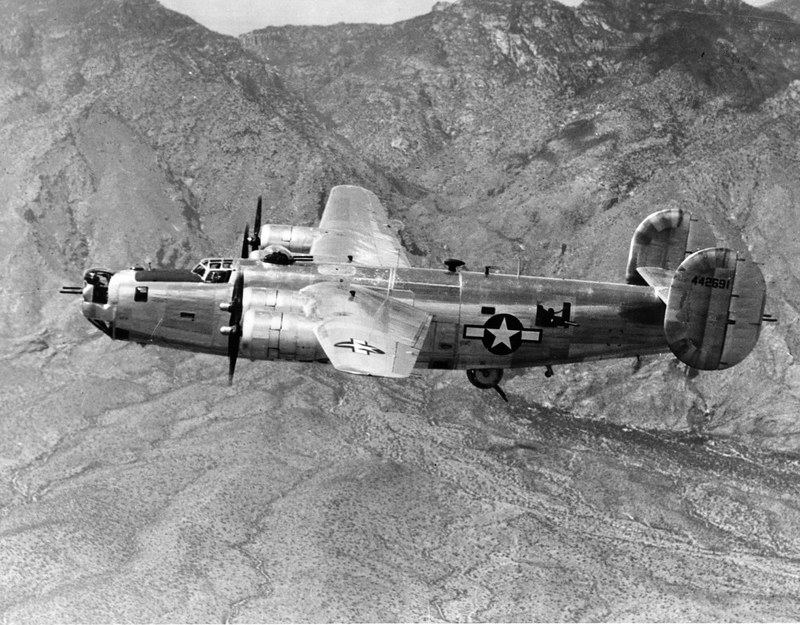
My father was trained as an engineer gunner on the B24, and later carried the top secret Norden bomb site. (BTW my father-in-law was a belly gunner on the B17). In my growing up years the message was plain: there were “good” guys and there were “bad” guys. The Germans = bad; the Americans = good. The Japanese = bad; the British = good. It was as clear as an old cowboy western. You could sometimes even tell which was which by the color of their hat!But in real life . . . it’s not always that easy, is it?
Now it may SEEM easy, but . . . let me tell you a true story.
I was working at the entry to the museum at Memorial Hall, Stone Mountain Park, several years ago. Across the hallway from my podium there was a theater where movies about the Old South and about the granite carving on Stone Mountain would play on a loop. One day a Japanese man emerged from the theater at the conclusion of the movies; clearly he had been taking copious notes on the concluding remarks of the narrator. He was particularly interested in the phrases that described “rising again from the ashes,” etc.
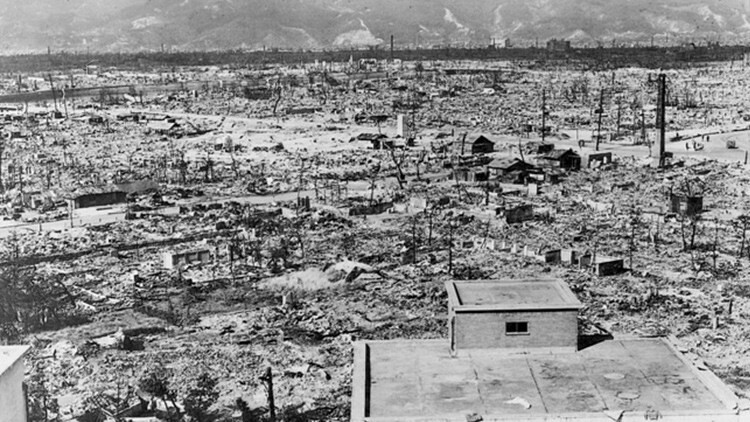
I was intrigued and so I engaged him in conversation. He led tours of Japanese people visiting the states. He wanted to borrow some of the movie’s language because it perfectly described the experience of the Japanese people after the end of WW2, especially with regard to the devastation in Hiroshima and Nagasaki.
Having visited a work camp in Austria (Mauthausen), and aware of what seemed like the universal belief that Hitler was evil and the Nazi army “bad” I assumed this Japanese man would see (as I did) that his country was the “bad” guy in the war, too.
But he DID NOT!
Much to my naive chagrin he said: “America may have won the war, but that doesn’t mean we were WRONG. All we wanted to do was the same thing Great Britain had been doing for many years – expand.”
I was flummoxed! As we all know, “history is written by the victors,” right? But it had never occurred to me that in this instance there would be ANYONE who would take that position.
Which . . . I think, is a part of Larson’s point in the book. Perspective is colored by numerous factors. And the right or wrong of a situation or belief cannot be determined by the passion and ardor of its proponents or adversaries. Strong beliefs do not equal truth.
So, where does that leave us? Survival of the fittest? Natural selection? Winner takes all?
The French Revolution, the American Civil War, the Tutsi’s and Hutu’s, Idi Amin, the Viet Cong, the Khmer Rouge, Hamas, the Allied and Axis powers, etc. Do we assign rightness or wrongness to these? Of course! Just understand that most (if not all) of these are operating out of a belief that they are in the “right.” That is, they are doing the”righteous” thing in their estimation.
It has been suggested that man cannot successfully govern himself; that there is need of a divine arbiter to regulate behavior. I believe there ARE absolute rights and wrongs. And I am thankful our country was founded on the notion that these absolutes do exist. But it is becoming increasingly hard to delineate these absolutes in modern society.
We really have not changed much since the days of our Civil War. Oh, of course, racism (though still present) is not in vogue anymore. But other erroneous points of view are becoming ingrained in us as surely as a plantation owner’s view of his slaves in 1860.
How does one arrive at what is true? How can you know when a cause is just, righteous, and worth dying for?
Lex, our black Lab/Pit mix, turned 16 last November, so he is officially “old.” In dog years that makes him 115.5.
“Mr. Routine” often sleeps in till 10 AM now, and his now-varying patterns control our day. If he’s not let out to poop or pee immediately after he rises he can longer hold it in, and sometimes I’m not sure he even tries.We are captives in our own house.
Lex still expects his afternoon walk, although it has been shortened a good bit. His injured left CCL (like the human ACL) will never heal, and he’s too old for surgery, so he uses it like an unpredictable cane when he walks. No more jumping, no more stair climbing, so we’ve bungee-corded the back deck to keep him from trying to go down like he did in former days.
A large mass the size of your fist sits on his right side, and another growth adorns the left side of his tail; various smaller lumps and odd places have cropped up all over, and his eye has a growth partly blocking his vision. Come to think of it, I’ve got some spots the dermatologist is treating, too. Lex sleeps most of the day, and all night, too. The vet says his blood work looks amazing and she’s surprised how alert he seems.
”Getting old ain’t for sissies,” my late father-in-law, Marty, used to say. How true that is.
My wife and I are feeling some of that, too. We have a running joke around our house; several, in fact. One is this oft repeated phrase: “Old people. Whada’ya do with ‘em?” It is usually said following some crazy mistake one or the other of us has made. Like the other day when I went to the grocery for the week’s shopping, filled the cart, and after the cashier had checked the numerous items . . . I realized I’d left the house without my wallet. (BTW this does not bode well for a perfectionist who tries to make the store-run in record time each week if left to his own devices). I had to laugh on the drive back home to retrieve my wallet, and I made sure to jokingly scold my wife for not including “take your wallet” on the grocery list.
Our muscles are atrophying (is that a word?), our joints ache, the chiropractor does what she can but she’s no miracle worker. My myopia seems to have improved as I age, but I can no longer see anything up close w/o glasses and PLENTY of light. My heart damage from 7 &1/2 years ago keeps me from doing anything very strenuous; in fact the nurses at cardiac rehab told me, “You know how you learned to get your heart rate up to 120 bpm and keep it there for 15 to 20 minutes for fitness? Don’t worry about that!” Hmmmm.
My wife has struggled with what was likely a TIA or something stroke related since 2020, resulting in some form of dysarthria and struggle with speech. She struggles with balance and has had several falls. Housework is increasingly hard. We are falling apart. So when I take Lex on his daily afternoon walk I sometimes think of us being much the same; two old guys strolling along at painfully slow speed, trudging, sludging, plodding along, feet and paws heavy on the pavement.
There ARE differences. He likes to eat dirt and moss; I don’t. He smells all along his route (which seldom varies), sometimes stopping for a mouthful or two of grass. I can’t smell much of anything anymore unless it’s dog poop in the house. He defecates wherever and whenever it suits him; I can still usually make it to the indoor porcelain throne.
My youngest daughter is back living with us. She feels like she’s running an assisted living facility (another one of our running jokes). When you reach what is now popularly being called “the last quarter of life” (like we’re in a football game – which, I must say, has many parallels to life) you suddenly have extreme appreciation for the ease with which you used to function. My legs have gotten so weak that without my arms (and something to cling to) I struggle to get up off the floor. Exercise for us is now walking in a large hardware store and doing a Silver Sneakers yoga video or two. Drinking coffee after 3 PM is unthinkable, and two visits to the bathroom during the night’s rest is a “good night” (sometimes it’s more than that).
Maybe we can learn a lesson or two from our dog, Lex. He stills gets so excited for his daily walk; he tries to spin around in excitement (which is scary to watch), then when we finally get outside he resorts to his labored and slow walking speed. He sleeps a great deal, and I have my afternoon nap. He still enjoys his meals most of the time, and NEVER forgets his after-dinner treat. He loves to see visitors in the house, strangers or not. He no longer has time (or energy) to chase other animals, and loud sounds annoy him (even conversation bothers him). He has learned when to use his feigned blindness or loss of hearing to his advantage.
Down the road . . . in the not-too-distant future . . . he will “move out” (as we have come to term it). And so will I. So will my wife. So must we all. In the meantime there is LIFE to be LIVED. And we had better get on with it.
Will there be dogs in heaven? Mark Twain seemed to think it would be a shame if there weren’t. I tend to agree.
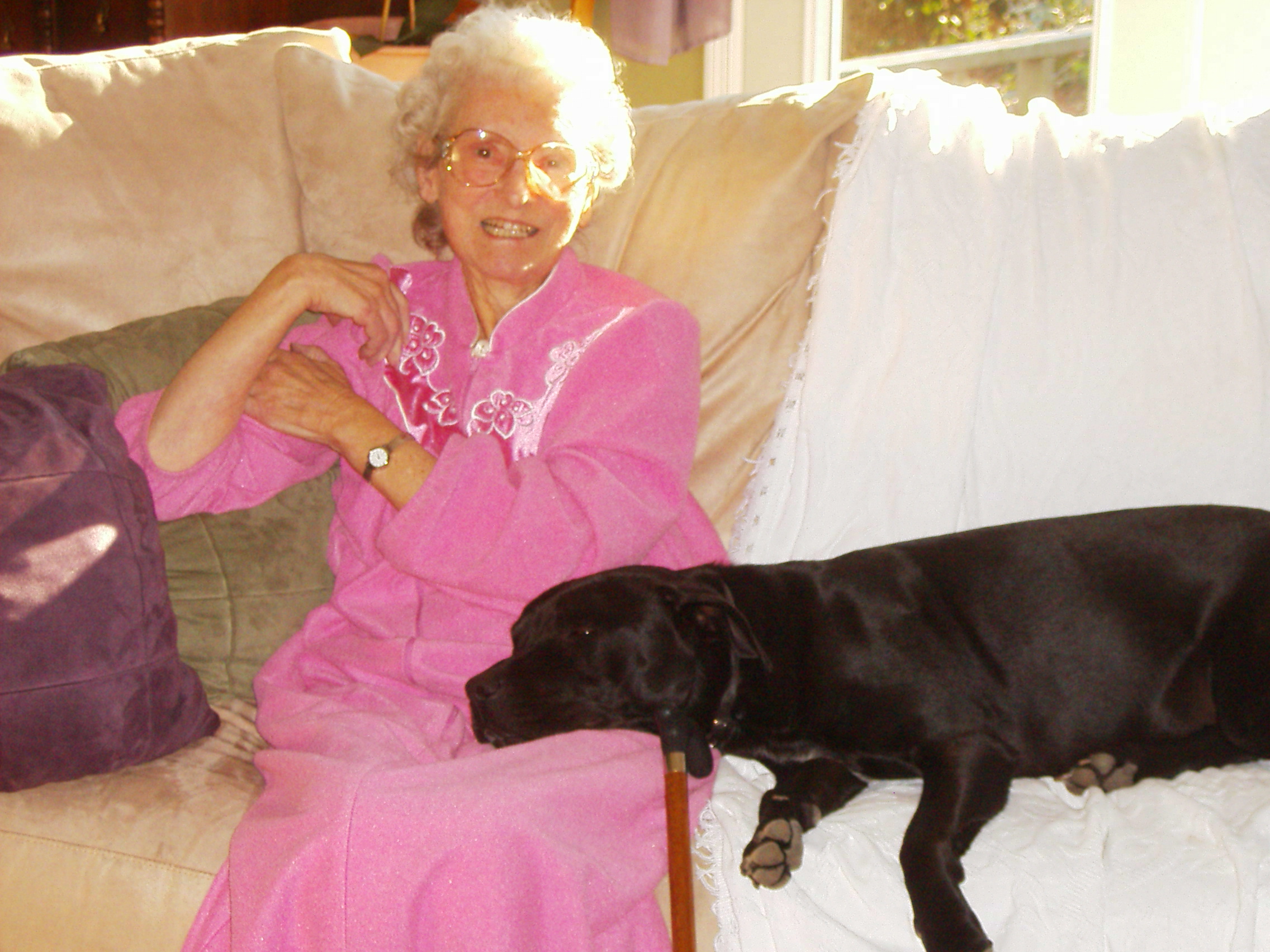
My late mother with a much younger Lex in a long ago time.
Horrific war in the Middle East, Israel versus Hamas, unspeakable brutality and loss of life; the continuing struggle between Ukraine and Russia; health care concerns over RSV and new strains of Covid; economic upheaval and the rise in the prices of virtually everything; uncertainty about our political future in the U.S.A.
We are inundated with national and international concerns. And often we sit in the comfort and security of our homes watching these issues unfold before our eyes, donning warm bedroom slippers and sipping the hot drink of our choice as the videos and pictures flash before us on our laptop screen or on the enormous high definition screen in the comfy family room. We adjust the lighting in the room to suit us as we stay seated in our fluffy chairs not needing to move a single muscle. It is winter in the South, and we are experiencing the coldest temperatures of 2023, lows in the mid 20s, highs in the 40s. But we are safe, shielded from the low temps as well as the turmoil of war.
Until . . . our central heat goes out. Brrr. It was 58 degrees in the house when we woke up this past Tuesday morning. Our HVAC people came out by noon that day to investigate. They thought they had diagnosed the problem, so they ordered a part and returned two days later to install it. But that didn’t resolve the issue. A subsequent visit that same day with more parts didn’t resolve it either. The new verdict is a blower motor. And hopefully they can install that today, but . . . there is no appointment scheduled yet this morning. We shall see.
The clothes washer is starting to act up now, too, leaking water onto the floor, and it seems confused about when to move from the wash cycle . . . . What’s next?
And in an instant we are: keeping up with a fire in our fireplace, buying load after load of wood from Lowe’s, constantly repositioning the logs, using heat from the oven in the kitchen, and keeping a borrowed electric space heater going in whatever room seems logical at the time.
Our world started to get real small Tuesday morning. And since.
I do care about world concerns, and I sympathize with those grieving in faraway places. But when I can’t watch it on the news in my warm secure home I find that my concerns become much more local. Much more tiny. Much more focused on keeping us somewhat warm, wearing coats in the house, not wanting to have the front door open any longer than necessary when the dog asks to go out to pee.
It’s a small world after all.
I suspect I’m not much different than you, even though you may be appalled at my lack of sensitivity. If you were in my place . . . what would you do? What would you feel?
In the early days of our nation, long before the internet, television, cable news and Facebook people used to get their news by word-of-mouth, or by the occasional visit to town where a local newspaper might tell of world events. One might learn in a letter from a relative that Aunt Betty died several months before. Or that there was a gold rush somewhere out in California. Nothing was instantaneous.
Cooking was from scratch, water was hauled in buckets, repairs were done by the owner of the property, and animals were cared for by the owner, too. To be clear, your family’s subsistence was up to you.
I’m not advocating we return to that life; the mortality rate was horrific, and the flu could just as well take your life as not. But it’s interesting to me how small that world was for a family, or even a community.
Then we got modern. More and more. “Progress,” we called it. A few balked but most did not. Life became more than just subsistence. And that is good. But we’ve also paid a price.
Numerous books like Alvin Toffler’s Future Shock observed our advancing civilization and predicted a level of despair to follow. He was correct. We have yet to learn how to balance our psyches; there is no time, because the next advance is in front of us before we have resolved the old ones.
But then . . . your central heat goes out. Now that creates a certain level of despair, no doubt. But it also clarifies some things, narrows some concerns, focuses your energies into a single strain: how do we keep warm?
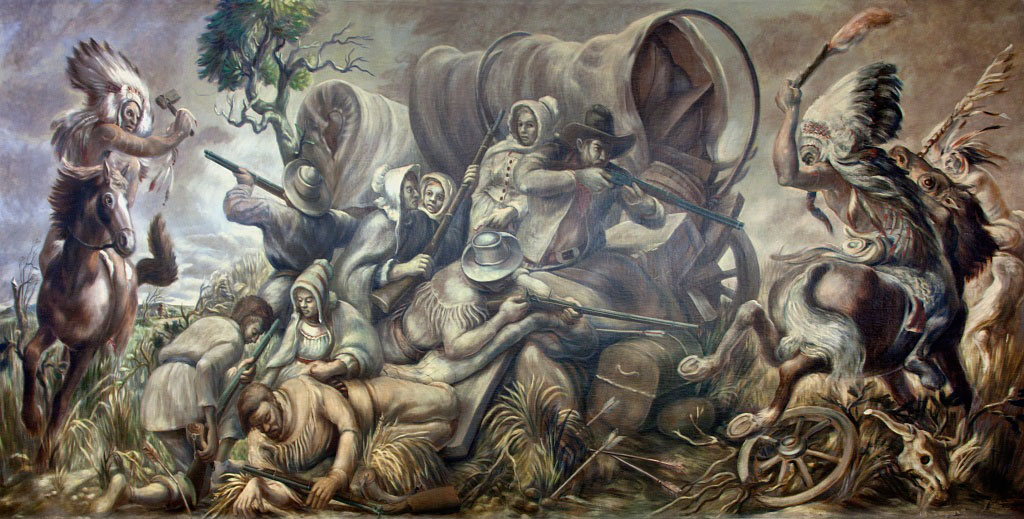
I know that eventually our present issue will be resolved. Thank goodness for innovation and science and the creation of central air and warm clothing from a department store. But for a few days . . . it is actually refreshing to experience burning a fire in the fireplace. Not to create a mood, or for the feeling of coziness as you curl up with a book. Not to add to the ambience of the room as you gaze at the large screen TV in front of you depicting the severe cold and deprivation experienced by the Donner Party in their trek out west. But . . . simply for heat. Simply to stay moderately warm in the wintertime.
Merry Christmas! We will definitely remember THIS one at our house.












 The Lost Story