Merry Xmas from Georgia, 2015

Xmas in Georgia 2015

We have been bemoaning our fate these past few days, grumbling over the fact that on Christmas Day the temperature might be 77ºF (a possible new record will be set), and there will likely be thunderstorms. And we’ve been asking odd questions like, “Will we have to run the air conditioner when we bake?” Wasn’t it 28ºF just a few mornings ago, ice covering the roof of our house; there were windshields to scrape. Was I dreaming?

Georgia’s weather is odd on a regular basis. But this . . . is a bit unusual even for us. It reminds me of Tucson, Arizona at Christmas, except this year they will be about 10 degrees colder than Atlanta.

I stepped outside this morning and took a picture of a pink rose bud forming. Nature is pretty savvy most of the time, but it can get thrown for a loop, too, on occasion. This is one of those times.

Topsy turvy.

I think it is safe to say I like things to be predictable. Oh, I love a good surprise as much as the next guy . . . as long as it falls into some pretty sane and predictable boundaries, that is.

But when something gets turned on its head . . . .

When your world is topsy turvy (so to speak), when the element of surprise becomes the norm, and disorder becomes the new order – that does not particularly appeal to me. At least, not without some counseling.

Reflecting on that this morning I was reminded – that is what this season is all about.

No matter your beliefs (or lack of beliefs) on the subject, you must admit that the Christmas story is topsy turvy in nature, anomalous at best. Consider this:

  • A baby (ostensibly illegitimate) born to a young woman in less-than-humble circumstances is actually the savior of the world
  • A small insignificant town is his designated birthplace
  • His arrival is apparent to just a few persons, and they are the social outcasts

The Christmas story is like a rose in winter, or like streams in a desert. It is like the anomalous springtime in Georgia this December, 2015. Odd. Out of place. Nevertheless, from this moment on it will be in the record books.

I always find it interesting when the TV weatherman reveals record temperatures or statistics about other natural phenomena: the Little Ice Age of 1887-1888, the winter of 1935-1936, the flood of my wife’s hometown (Portsmouth, OH) in the winter of 1937. Often severe winters are preceded by an unusually warm winter.

[Ivan Doig’s classic book, Dancing at the Rascal Fair, recounts the plight of immigrants coming to Montana during a record breaking brutal winter; it is well worth the read]

Maybe you’re not curious (or self-absorbed) like me, but I have always been interested in knowing what the weather was like the day I was born. The day I was born the temperature in Chattanooga, TN had a wider range than normal; the low was 28ºF and the high was 66ºF. (I was premature, so I had to live in an incubator for a few days. The weather inside there was pretty consistent as I recall).

Clearly, my premature birth (4 to 7 weeks) was not something my parents had planned. My brother was a January baby, and I guess, had I gestated to term, I might have been one, too. Mother had to leave the hospital without me. Again, not according to plan.

In a very real sense when we celebrate Christmas (or Xmas if you prefer the abbreviated version which uses the first Greek letter χ for the word Christ) we remember, and pay homage to, the unpredictability of our lives. And I do not mean this in a negative sense; rather, the converse.

If you go to a 12 Step meeting like AA (or any number of others) you will eventually hear someone say, “My best plans and intentions got me here.” Or “my best thinking got me here.” It is, of course, an admission that often our attempts to plan, control, navigate, and lord over our lives ends in confusion. Persons are hurt, relationships are damaged, and our vision of how life ought to be just seems to crumble into the proverbial dust, much to our chagrin.

The Christmas story is all about good coming out of apparent ill, great coming out of exceedingly small, inexpressible joy being born from the sad and lowly, the proverbial beauty from ashes.

It went down in the record books, of course, as you know. We date our calendars by it in the Western World. And in a very real sense . . . nothing will ever be the same because of it. Countless persons have experienced life changing events because that baby was born.

Rather than see this year’s weather as an anomaly that feels less than Xmas, or as the result of an El Niño, I can’t help but see it as a reminder that what I can’t predict is often the very thing that saves me, that thwarted plans are very often the opportunity for a better-than-imaginable result to reveal itself.

And no, this is not just wishful thinking, not just the power of positive thinking; rather, it is the humble admission that I am not as powerful as I think I am, that sometimes a rose can bloom in winter, and that when it “rains on my parade” it is not necessarily a bad day.

This Christmas will go down in the record books, record temperatures will be put into computer data bases all across the country. And in the future you will occasionally hear a reference to the oddity of this winter. But this anomalous winter will change very little in our world. We will remark about it this year, and possibly the next, then it will only be referenced in passing.

But the first Christmas . . . . Well, that is another story altogether. Unpredictable. Unprecedented. Unending in its effects.

Posted in Family History, Stories, Uncategorized | Tagged , , , , , , , , , , , , , , , , , | 2 Comments

It Seems to Me . . .

Okay, okay! Bring on the hate mail.

I try very hard not to be offensive to those who are kind enough to read one or more of my blogs, but as comedian Brian Regan says (after making a similar disclaimer): “Here we go.”

We have succeeded in training a whole generation [shall we call this group “millennials”?] to: wear their feelings on their sleeve, be vigilant in watching for subtle racial innuendos, always be on guard for any hint of an ethnic or sexist remark, and react in the extreme when they encounter anything that smacks of exclusivity.

As a result we have women in combat, persons in large corporations promoted to positions beyond their capabilities simply because of their race, unisex bathrooms in some high schools, felons convicted of murder, rape, etc. who feel unfairly treated because they were tried in the adult criminal justice system when they were still just juveniles (allegedly unable to make adult decisions or understand the legal nomenclature of the courtroom), and health insurance companies unable to keep up with the nuances of our redefinitions of human sexuality, gender identification, and the resultant ramifications.

We have created a society whose undercurrent of sensitivity is so vast we scarcely know how to function. We fear litigation at every turn, and so we are first-and-foremost in the business of protecting ourselves against possible objections, even fortuitous ones.

Television shows like The Office make light of our dilemma by showing the office manager (Michael Scott, played by Steve Carell) being anything BUT sensitive as he manages a failing paper company, and sets the tone for the group of misfits in his Scranton office.

Of course, we laugh. Not only because the situations depicted are so uncomfortable, but also because the office misfits are so believable to us. Exaggerated, yes. But close enough to the real thing that we experience identification.

But in our real worlds . . . we no longer know how to laugh about these things.

And so, when a supposed expert was asked (in a recent NPR interview) about the racial discrimination that exists currently even on Ivy League college campuses, he cited as one example (and he said there were more than one hundred) a situation where a college professor is discussing poverty and/or the ghetto, and he automatically looks to the African-American students for personal insights on the subject.

Granted, the chances these students have experienced that to which he refers is very small. But the fact that he seems to look to them reveals his own prejudices and misinformation. If that is all the prejudice and misinformation experienced by students in that classroom in a semester, then I say they are very fortunate.

What is just as likely, however, is that someone reading this blog might criticize me for suggesting the professor is a “he” and not a “she.” That is the extent to which we have become infected by this insistence and obsession on equality.

We have produced a generation of thin-skinned, militaristic, passionately misdirected persons who have embraced a watchword that unifies them: social justice. Of course, in and of itself this theme is admirable. But the proverbial “devil is in the details.”

And now this point of view has spilled over into older generations, too. We are fast becoming a society quick to take offense, our fists poised to fight, guns drawn, feet planted, ready to charge ahead with our sword out of its scabbard. That may seem appropriate in our current terrorist climate, but it is way out of place when the only terror we experience is someone else’s ignorance or lack of understanding.

You will never legislate that out of existence.

When I was in college I was part of a group of students that tried to oust a professor; we had decided he was “too liberal” to be teaching us. He was a fine man. He just had a bit more “open” view of things than a number of us. We decided that the proverbial “tail” ought to be able to “wag the dog.” I no longer recall what happened to him now.

What I do know is that in years to come I far surpassed the liberalism of the ideas he espoused. But in those early years I had put myself in a position to critique and expose someone from whom I should have listened, learned, and considered.

It seems to me that the current social dilemma we are in encourages the ones who ought to be learning to instead be judge and jury for those who ought to be instructing. And in the midst of this upheaval an atmosphere of injustice has been spawned; a doctrine that purports unity, equality, and fairness has instead birthed a bastard whose heart and soul is all about highlighting the differences between races, ethnicities, and genders.

Of course, I am a white, southern born, middle-class male in my sixties. So, my point of view should be discounted, I suppose. But it seems to me we have empowered the bullies, coddled the criminals, and created a society that waves the flag of freedom while simultaneously controlling every move its patrons make.

Well, if you have read this far . . . Thanks! I needed to get that off my chest.

I know there are persons who have been badly hurt in this world, minorities that have experienced painful discrimination I can never hope to comprehend. And our country has made some horrible mistakes in its history, sometimes with full intent. But the way we sometimes seek to heal the wounds is not productive at all.

And I fear the misguided attitudes that power our attempts at social therapy will inadvertently produce citizens who only understand the pronouns “we” and “us” as they are juxtaposed with a “them.”

Posted in Uncategorized | Tagged , , , , , , , , , , , , , , , , , , , , , , , , , , , , , | 16 Comments

Helicopter vs. Free-Range Parenting

I recently listened to a National Public Radio interview where the miseries caused by “helicopter parenting” were enumerated. The discussion featured a prominent scholar/author on the subject, as well as a Kennesaw State University counselor. It was quite interesting.

Evidently, emotional immaturity is on-the-rise on college campuses, and the occurrence of emotional breakdowns over minor challenges and struggles is commonplace.

The culprit?

Helicopter parenting. A term coined in the late 1960s (Haim Ginott, 1969) that has become representative of overprotective, over involved, smothering parents, more recently described as drones.

On the opposite side of the spectrum is what has been called “free-range parenting” (Lenore Skenazy, 2009). This approach encourages children to be age-appropriately-independent, and develop their personal potential in situations that are not risk free. Some have criticized this approach, saying it is simply what used to be called “parenting.”

There has always been disagreement with regard to child parenting and child education methods: too lenient, too disciplined; too amorphous, too structured. And like the pendulum, we tend to vacillate between the extremes, possibly because that makes it easier for us to see the difference between the points being debated.

Some tend to balk at positions that bear too much similarity; they get lost in the minutiae. In addition, many carry the old “if a little is good, more is better” approach, so they are more comfortable migrating toward one extreme or the other. Our sociopolitical postures seem to bear this out as well.

The permissiveness of the 1960s ushered in an approach to living, child rearing, education, religion, etc. that has had half a century to ferment. Dr. Spock notwithstanding, so-called “conservative” approaches to child rearing have remained, but I think it is safe to say that the general tenor of American society (not to mention many other developed societies) still embraces the so-called “freedoms” espoused by the activists of the 1960s; we are the most “tolerant” we have ever been. And some would argue, the most unhappy.

As I listened to the aforementioned interview I was intrigued when the scholar/author denigrated the “helicopter” parents, saying that children must be allowed to interact with one another without parental supervision, thereby helping them to discover on their own how to function as an adult, and gain the strength of character only attained through personal, unaided interaction with the environment.

My mind immediately went back to a book I read in school many years ago: Lord of the Flies (William Golding, 1954), which illustrates what happens when children are allowed to freely arrive at their own rules of behavior when there is no adult supervision. If it is true that Golding’s book was a direct reaction to the 1858 classic, The Coral Island, by R.M. Ballantyne, then it illustrates our current situation precisely, and gives a bit of history to the swinging pendulum of moral sophistication.

My wife and I chose to home school our two children. Now I know that immediately makes us suspect to some readers. Be that as it may, we discovered in our research (prior to embarking on this “risky” endeavor) that parenting methods and influences of the past changed radically when children left life “in the country” where they worked alongside their parents; they exchanged relationships with adults, siblings and neighbors for relationships primarily with friends at school. [See Raising Children for Success, by H. Stephen Glenn, with Jane Nelsen, 1987]

Close relationships between children and parents soon became an anomaly, and the norm was represented by the proverbial rift between the two. Parents would more often than not roll their eyes and say, “Just wait until you have teenagers.” And their children would never dream of sharing their deepest feelings with their parental nemeses; and they do their share of eye-rolling, too.

I tell young parents just the opposite: “Don’t buy into the lie that your children will be your enemies, and that you will lose their love, respect, and intimacy when they reach their teen years.” It is simply not true.

But, of course, that depends, in part, on how you approach your parenting. Smothering can foment rebellion, but unbridled freedom can do the same.

We may be at a point in our society where we are approaching “the perfect storm.” Our worship of “tolerance” has all but caused us to lose our identity as a society. Somehow many have come up with the notion that we are becoming more and more civilized with each generation, and that we are on a path toward equality and social awareness. We fancy ourselves defenders of the less fortunate and the downtrodden, and we applaud those who propound extremist views and aberrant ideologies (unless they are terrorists – we are not that open minded).

Paranoia has a strangle hold on us, and every hint of racial injustice that is communicated through the plethora of social media outlets exacerbates it. Difficult times are ahead, and our children may not be up to the task that awaits them.

Granted, I am no expert on education or child rearing. I taught high school (and some junior high school) for 10 years in Tennessee; my wife taught about the same length of time in Ohio and Tennessee. We raised two children and we were, at times, overprotective – especially as compared with the rearing of some of their contemporaries. There is no perfect balance, at least not one that is attainable.

But perfection is hardly the point. Both extremes appear wrong: helicoptering and free-ranging. But there is a far more important question that must be answered. For the truth is that each set of parents will lean toward one extreme or the other. And both can train children who are successful people in our society, able to contribute valiantly in the trying times ahead.

The real question is whether or not parents will embrace the responsibility to invest in their children (no matter the style), guide them, and nurture them, or whether they will assume that the children can raise themselves either by individual personal direction or in the crucible of their herd.

When I was 10 years old my father decided that my older brother and I should “have it out,” i.e. fight. This was his attempt (I believe) to settle a score he never got to settle with his own older brother. Trouble is, my brother is almost 3 years older than me, and he easily beat me up. Undoubtedly, my father envisioned it going another way, but it was his attempt to bow out of the fracas he typically had with my brother, and allow me to defend myself (on his behalf). I lost miserably.

Some might suggest I learned something important in that bout, but I think I just got a bloody nose and avoided my brother’s fists. Actually, I already knew about the latter danger, so that lesson was somewhat redundant.

In certain segments of our current society it appears we have embraced the notion that children can raise themselves, and we are experiencing the detrimental effects of that ideology.

Children learn how to be adults by modeling their adult model’s behavior, not by modeling the behaviors and attitudes of other children who are as clueless as they are about what this thing called “life” is all about. Parents must gladly embrace this modeling role and bring their children alongside them in a variety of situations so that when they are absent the child will know how to interact with others.

My hope is that we rethink the notion that children are best raised when they raise themselves, and rethink it quickly. To do so will require that we go against the grain of popular thought and cutting-edge educational theory. It will require a metamorphosis of sorts.

To refuse this change will result in something more Kafkaesque than we can imagine.

Posted in Stories, Uncategorized | Tagged , , , , , , , , , , , , , , , , , , , , , , , , , , , , , , , , , , , | 4 Comments

Ganesh in Georgia

Ganesh is the Hindu god responsible for controlling life obstacles and providing wisdom. His image, popular and unmistakable, is characterized by the head of an elephant.

The annual celebration, featuring brightly colored figurines of this god (ranging in size from mere inches to 70 feet in height), can be seen all over the world, generally falling in the time period between August and September.

Near the conclusion of the festivities the figurines are immersed in water. Many years ago they were made of clay, and the materials the idol was made of returned to earth without damaging the environment; however, that is no longer usually the case (they are often made of plaster now).

I was a witness to the vast number of people who turned out for this year’s celebration on the Georgia coast, faces painted with red, large groups of men carrying massive idols on bases, making their way through the sand and headed toward a predetermined spot on South Tybee Island. Throngs of men, women, children; families dressed in a variety of colors, pouring their way toward a spot of worship. There were literally hundreds who passed the house where we were.

We had planned to have a family portrait taken out by the shoreline, and it just so happened the place the crowd was headed was exactly where we had planned to shoot the picture. Oh well, we laughed . . . and adjusted our plans; we could find an alternate spot.

We could have no inkling of what was in store that evening, Sunday, September 27, 2015.

We made our way to the edge of the rising tide, north and east of the large throng of people who had gathered. We had to be photogenic quickly, because the tide was moving in, encroaching on about three feet of shoreline with each wash of the waves. My four-year-old grandson was in and out of the water, but managed some great pictures. My almost-one-year-old granddaughter stayed in her father’s arms; the rest of us did our best to look good, but the strong wind was wreaking havoc on our adult coiffures.

After having to relocate the tripod and other photographic paraphernalia several times to avoid the rising tide . . . we were finally done. But as we milled about, enjoying the last bits of evening before returning indoors, the intoxicating cadence of the waves was interrupted by sirens. Soon lifeguards zoomed past with vehicle light bars lit, heading for the spot where the Hindu ceremony was being held.

In just moments two vehicles returned the way they had come; we saw two lifeless men in the back (one in each vehicle) with lifeguards performing CPR as they sped past us. Police began to appear, and soon the Coast Guard employed a rescue helicopter to search for what was clearly a missing person or persons in the water. Rescue efforts were being made with the use of kayaks and and jet skis as well.

We were witnessing the truth of the South Tybee warnings about rip currents in that exact area. It appears that five persons had been swept away in the channel between the shore and the sandbar near Little Tybee. Four were taken to the hospital, two survived. A fifth was missing, and the search continued until just after 10:00 AM on Tuesday, Sept. 29, when the body was found. The deceased Indian men were ages 36, 39, and 41 according to news reports.

Water weighs 65 pounds per cubic foot, a sizable amount. And a rip current utilizes that weight to move objects even in shallow water. You cannot defeat it; rather, you must swim with it or allow it to take you out away from the shore until it releases you. Calmness is important in this scenario, but I am not sure I would be up to it, personally.

In 2013 there were 17 who were swept away in the Yamuna river in New Delhi as they celebrated this same event on Indian soil. What a tragedy.

I have an iPhone picture of the Hindu men unloading two large idols of the elephant god off a red truck and trailer just below the house where we were staying. We watched as they struggled to lift the objects of devotion and maneuvered their way up, then down the wooden boardwalk and across the sand, preceded and followed by throngs of worshipers.

Ganesh Mahotsav 2015

Ganesh Mahotsav 2015

There was a festive spirit in the air, a contagious joy. Nothing could have prepared them for the darkness that was coming.

Life is precious.

As my son-in-law said to me later that evening, human beings are unbelievably resilient and amazingly fragile at the same time. How true that is.

Our devastation that night was like a pall cast over us. Of course, nothing to compare with the families of those lost that day. But that is their story. We were left with our own story.

And our story moved on the next day to: watching a man right beside us catch a small shark (about 4 feet long) with a fishing rod, bring it up in a fishing net, and release it from the pier; an interesting, interactive, kid-friendly, sea life museum; the wonderful Georgia State Railroad Museum in downtown Savannah; Chik-fil-a lunch-on-the-run; and then a longer-than-necessary ride back home (that story is for another time).

We are tired from our weekend trip, but back home. Nothing earth-shattering has been altered in our lives. I cannot say that for the families of the victims of that accident on South Tybee Island. We may all remember September 2015 at Tybee Island. But not with the same intensity.

Nevertheless, I am left with a feeling . . . one that remains quite deep in me . . . a realization that my life intersected with the lives of persons I may never meet again, in a place I may never see again; the intersection was brief . . . but monumental.

My wife said she saw a young boy, about ten years old, with tears in his eyes, and his father asked him what was wrong. He said, “Are they gonna be all right?” His father responded, “You don’t have to cry. They’re all going to be all right. But that’s why I don’t want you going out too deep into the water . . . .”

They were not all right, of course.

Each of us has an “end” to face. For some it may come in their sleep and without pain. For others it may come at the conclusion of a long, pain-filled bout with some disease. Still others may come to a sudden, dramatic, tragic end. But rest assured – there will be an end.

One day some blogger may sit and write about my final moments. He or she may say, “I didn’t know him, but it was a terrible . . . .” Or they just might write about you.

No matter. The intersections will occur again and again. Persons unknown to you will be present right along with family when you pass, most likely. The intersection will happen. Some will notice it. Others may not.

I choose to notice it. I cannot escape it.

Posted in Family History, Stories, Uncategorized | Tagged , , , , , , , , , , , , , , , , , , , , , | 2 Comments

Truth, or Falsies?

It was just a few days ago that I heard it for the first time: the word “falsies.”

Actually, it wasn’t the very first time I’d heard the word; rather, it was the first time I had heard it used to refer to something other than that to which I had first heard it used.

Okay. Okay. I am back pedaling, aren’t I?

Bosom pads for breasts. Falsies. We talked about them in junior high school in the 1960s when our hormones were kicking in. Of course, nowadays kids are probably talking about them in elementary school. Kindergarten, perhaps? Is there no innocence?

BUT . . . the way I heard it used the other day . . . it made reference to mascara, a Maybelline makeup product. That one was new to me.

The subject of cleavage enhancement has a long history, dating back to the Victorian era. Evidently we aren’t the first folks to engage in serious image management. We human beings aren’t comfortable with “the naked truth,” as a quote I often employ says. It continues: “so we want to cover it up just a little bit.”

The word “false” originally carried with it the notion of “fake” or even “deceitful.” We seldom think of it that way when we answer a bunch of True/False questions; we tend to think more along the lines of Right/Wrong, or Correct/Incorrect.

But when we use the word “falsies” we readily understand that fakery and deceit are implied, even when we may have no intent to do harm with that deceit.

Which brings me to the reason I thought about writing this blog entry to begin with (I know, some of you are thinking, “why doesn’t he just get ON with it?”). Sorry! The writer’s mind is a complex and confusing arena filled with hungry lions and unwitting gazelles.

I have a false tooth.

There! Are you satisfied now?

Several weeks ago I was eating a quick lunch before hurrying off to one of my part-time jobs. I was eating and talking, and . . . crunch! All of a sudden I bit down on my metal fork, and it felt like my bottom front teeth collapsed beneath it. When I looked for the damage in the mirror . . . there was nothing.

The tooth in question continued to hurt; it was somewhat loose, too. I knew I was in for a dental visit but I put it off for another day, and went on in to work.

The next morning I sat in my dentist’s chair awaiting the official verdict. I could see the X-ray for myself on the computer screen nearby – it looked like the internal resorption I had experienced a few years ago. The roots of the tooth were just a dark mass. Ugh!

A trip to the endodontist made it clear that a root canal and subsequent crowning would not work on this tooth. So, I returned to my dentist for an extraction. I was informed that replacing the tooth with an implant (if it was even feasible in that spot) would cost about $5,000.00. So, I asked for the cheapest option, and agreed to it post haste.

Goop was stuck in my mouth, it hardened quickly so that a mold was formed, and then someone in a distant location created an appliance with ONE TOOTH on it. Tailor made for my mouth. How flattering!

My family has enjoyed fits of laughter over this, of course. They liken me to my wife’s parents (who haven’t hardly had any teeth for 40 years); they soak their false teeth in a container every night (at least I HOPE they do), so if you speak to them just before they retire at night you may engage in a brief conversation with a toothless elder.

Sigh.

I have a false tooth.

It is still hard for me to conceive of it as I sit here in this bookstore and write. I am currently not wearing it, so my tongue regularly visits the space between my bottom front teeth and says, “hello.”

When I am wearing it, the appliance (which fits nicely over my gums and is secured by eye teeth) makes me salivate, or at least it causes saliva to collect in large amounts in places it did not collect previously. As a result I talk kind of funny now. I don’t think I would ever try to sing with this thing in for fear of drowning as I took a breath for a long note.

It is difficult to eat with the false tooth in, too. It isn’t really made to tackle steak or anything challenging like that, and even when chewing with my “true” (real) teeth, particles of food get stuck beneath the appliance and play tricks of their own on me.

I am officially old, I guess. In two months I will be a mere 62, but . . . clearly I am old. False teeth DO NOT LIE! They always tell the TRUTH.

Part of what makes this difficult is that my parents (who both lived into their late 80s) never had to have false teeth. Sure, they had crowns, bridges, etc.

But nothing FALSE.

Am I being deceitful when I wear my deceitful tooth? Am I a fake?

That question is one for those who deal in metaphysics, I suppose. Not for those of us who simply want to appear to have a full set of teeth.

Posted in Comedy, Family History, Stories, Uncategorized | Tagged , , , , , , , , , , , , , , , , , , , | 5 Comments

It’s a Small World

Richard and Robert Sherman penned these words for the 1964 New York World’s Fair. The song, which arguably is the most translated and performed song in history, was written by the most prolific motion-picture musical songwriting duo of all time. It has come to be so closely associated with Disney as to make the two interchangeable.

Indeed, it is a small world (after all). That is, in spite of great distances, various languages, differing cultures, etc., there are uncanny personal connections which continually emerge. This may be due, in part, to the internet and the speed of modern transportation. For seldom does a day go by that I do not hear or read of another example which illustrates our “six degrees of separation” (put forth by the Hungarian, Frigyes Karinthy, 1929; then John Guare, 1990).

It is truly amazing.

Our world has shrunken. And because it has we have become more cosmopolitan in our outlook. We discuss world peace, world hunger, global warming, and issues with universal implications. And we are quite at home in doing so.

But I have come to see that there is at least one aspect of life where our world is exceedingly small; where it is a “small, small world.” Not because we have opened our arms so widely as to encompass the globe. And not because our perspective has become so universal.

On the contrary. It is because, in at least this one regard . . . we truly become small; that is, we retreat into ourselves, and in a very real sense, “our world” is reduced almost to the size of our own person.

Of course, I am speaking of death. Not a popular subject, I understand. But one which touches us all at various moments of our lives. And . . . ultimately, at one particular moment: our own death.

I first was made aware of this when my late mother shared with me her observation of my father just days before he passed away. She said he seemed to be retreating into himself; she felt the distance from him, personally. It was as if he was retreating to a place only he could go; there was no room for a shared experience.

And then I observed it in her, too, just before she passed. Admittedly, it is hard to evaluate the effect of some of the drugs she was on (to relieve her from the drowning feeling of her cardio-pulmonary hypertension), so I can never say her “distance” was in no way drug induced.

My father rallied on his last day, singing and enjoying a nice dinner. Then he was gone. Mother rallied, too, but only long enough to have a one word conversation with the nurse at her bedside. Then, she too, was gone.

Mortality.

If one is not killed instantly in a bomb blast or a car accident, etc., but has time to experience days/weeks preparing for his/her death, then I wonder if it is fair to say that his/her world gets smaller and smaller. It gets smaller until it reaches a place where introspective focus is complete, the focus puller adjusting to the changing distance between actor and camera.

No doubt, we live together in a world of laughter, tears, hopes and fears (as the song says); there is so much that we share. It is a small, small world.

And yet . . . .

We could say there is a sense in which that world gets larger and larger at death, so large, in fact, that it is too enormous for us to continue to embrace. We cease talking globally, our perspective diminishes, and we can only put our arms around ourselves.

Oh, we may hold the hand of a loved one, a life mate, a close friend or a child. And we may smile and express our love (if we are able to do so). But . . . “our world” may be bound by the four walls of a room in which we lie, or smaller yet – it may be limited to the confines of our mind.

We grow up from infancy, learn the importance of interaction with others, align ourselves with friends and/or life mates, and live out our lives in community. But when the end approaches, when our final day(s) arrive, when it is time for us to sing our swan song, leave the stage once and for all, and leave the audience we entertained with the task of evaluating our act . . .

We go behind the curtain alone.

Posted in Aging Parents, Assisted Living, Family History, Nursing Homes, Stories, Uncategorized | Tagged , , , , , , , , , , , , , , , , , | 4 Comments

Anatomy of a Writer

What makes someone a writer?

My mother was a great writer. I could say she “had a way with words,” but that might not tell you very much. I can say that whenever I read something she wrote I find myself smiling at the pictures she paints with words, and that the word “clever” often forms itself on my lips.

There was a cuteness in the way she delivered a sentence, an adorableness that seemed to be tucked in between the words, like the smell of lilacs announcing the coming of spring.

Frederick Buechner is a great writer. My cousin, John, is a great writer, too. As is my uncle, John. [Maybe it’s in the name? My own name, of course, means John in Russian.]

It is easiest, of course, for me to discuss my own writing; therein I can give you first hand information. But I must warn you: some of this may not be pretty.

You see, I am enamored with words. Words pass through my mind’s eye like wild birds darting to and fro in the garden: each has an important mission, but you cannot always tell what it is.

When I listen to a person talk I am constantly evaluating his/her choice of words, syntax, and manner of delivery. If I catch an allusion to another subject with parallel word usage I am tempted to make a joking comment exposing that allusion. If I note an error in syntax I am apt to pull it into the light. Let’s just say I will make the most of an error if I can do so. And all of this happens without conscious intent. It is automatic. It is in the DNA of the writer.

I understand I have just painted myself in a very poor light. Forgive me.

You see, I am a recovering wordaholic.

Part of the skill set necessary to being a writer includes a mind that scrutinizes words: their denotations, connotations, and the overall historical context into which they fit. The honing of this skill sometimes lends itself to negative personal interactions.

Another part of my writer’s psyche concerns itself with pronunciation. This, too, is a sensitive area; many people have trouble with pronunciation. But to a writer, the mispronunciation of a word spawns an opportunity for the creative juices of allusion to flow.

Archie Bunker notwithstanding, communication still continues to happen with a modicum of success in our world. But to a writer like me, the Archie’s of this world make it a great deal more fun in which to engage.

The conundrum, of course, is that the wordaholic is apt to miss honest communication with another person by constantly focusing on the tools used in that communication. That is his/her Achilles’ heel. For example, if you are constantly on guard for the double entendre you might miss the whole tenor of the conversation. [Come on, some of you were just now thinking of making a musical remark about . . . oh, never mind].

To me, writing involves paying attention . . . TO EVERYTHING. All at once.

By that I mean that the sounds, hues, flavors and emotional complexes of a word or phrase are constantly on the palette in front of the writer. He/she notices the texture of the walls of the writing room (so to speak), the color of the paint, the ambient sounds (inside and out), the temperature, etc.

Everything informs the writer. The news of the day, the pain caused by a harsh word, the sparkle of sunlight, the smell of fresh baked bread. And from that immersion into life, sometimes even the banality of life, the writer watches the sky of his/her heart for a fowl carrying a word that will somehow bring everything into focus and sensibility.

There is an element of the magical about it all, no doubt. There is a sense in which the writer feels that all these multifarious elements might perchance converge in an instant. And . . . if he/she is watching closely . . . it might be visible in all its mysterious glory.

Then . . . the writer waits for the tidal wave of words, the tsunami of descriptors, the fallout of exposed phrases to describe it.

But alas, I must hurry off to my 12 Step Meeting. “Hi! I’m Ivan. And I’m a wordaholic.”

P.S. But I had intended to write about the anatomy of the writer. There’s not much to say, really. The anatomy of the writer is much the same as any other human being: skin protecting a number of vital organs. The only difference may be that the writer is guided by his/her heart more than by his/her mind.

Wait!

Um. I guess there is no difference.

Posted in Family History, Stories, Uncategorized | Tagged , , , , , , , , , , | 3 Comments

Everybody Knows This, Right?

I have been working in a garden from time to time at one of my part-time jobs this year. And in spite of my ripe old age I have actually learned a little in the process. I learned that cotton has a beautiful bloom, as does okra, artichoke, and even peanuts (to name just a few).
In fact, just a few days ago I came to a conclusion that astounded me [NOTE : I am still in the first grade when it comes to gardening]. I had always thought that flowers flowered, and vegetables vegetabled (or some such creative word), but now I know that . . . [wait for it] . . .

Vegetables flower, too, just like flowers flower; and their blooms are beautiful!

Maybe you’ve never had a revelation like that in your life. You know, something that probably everybody else knows – except YOU.

Have you ever listened to other people discussing a subject and find yourself thinking, “I must have missed that year in school”? As I mentioned in a previous post, I was in my 50s before I learned how to correctly set the side mirrors in my car.

I have always assumed that government agencies like the FDA (Food and Drug Administration), the EPA (Environmental Protection Agency), etc., all functioned with the same basic approach to approve products in the U.S.A., i.e. exhaustive and strict testing is done before a product is made available to American consumers. And I have been glad that our country scrutinizes first before allowing anything that could endanger potential customers.

But I was wrong.

I learned just this week that the EPA operates under a very different standard than the FDA, i.e. a product is innocent until proven guilty (employing a common legal notion of ours). This has allowed the American Chemical Council to protect large chemical corporations from environmentalists who find numberless everyday products on our grocery and drug store shelves to be dangerous to consumers. The chemical lobbyists are a formidable force, and the almighty dollar once again reigns supreme. Even in the good old U.S.A.

But then, everybody knows this, right?

Just a few weeks ago I learned that Prohibition was not just about righteous indignation over the pervasive ill effects of alcohol in our society in 1920; rather, it was, in part, a power ploy by none other than John D. Rockefeller to defeat Henry Ford and his ethanol using Model T Ford.

As a boy I was taught the cause of the Civil War had to do with the moral question of slavery, and that Abraham Lincoln was a champion for the equality of the negro race. Since that time I have come to understand that Lincoln (whom I admire greatly) was influenced by a number of political expediencies when he wrote the Emancipation Proclamation (which became official in January 1863). And that things are not always as cut-and-dried as they may first appear.

Everybody knows this, right?

As a professor in graduate school shared with me years ago, R.D. Laing wrote in Knots:

“There is something I don’t know that I am supposed to know.
I don’t know what it is I don’t know and yet am supposed to know,
and I feel I look stupid if I seem both not to know it and not know what it is I don’t
know.
Therefore I pretend I know it. This is nerve-racking since I don’t know what I must
pretend to know. Therefore I pretend I know everything.
I feel you know what I am supposed to know but you can’t tell me what it is because
you don’t know that I don’t know what it is.
You may know what I don’t know, but now I don’t know it, and I can’t tell you. So you
will have to tell me everything.”

We are all lifelong learners, you and I. And if we keep our eyes and hearts open there are countless discoveries ahead of us, some are even life changing, “game changers” (in today’s vernacular).

Doubtless there will be times when you think to yourself, “Everybody knows this but ME.” But no matter! Everyone else is in the same proverbial boat, alternately taking in water, then sailing ahead with the wind at his/her back.

The trick (if it really is a trick) is to refuse to pretend.

Posted in Family History, Stories, Uncategorized | Tagged , , , , , , , , , , , , , , , | 8 Comments

Senior Class

There’s nothing quite like your Senior Year, is there? Whether it’s in high school or in college, there is a status that goes with being a senior. You have finally arrived, reached the plateau, climbed to the summit.

My senior year in high school was in Tucson, Arizona in 1970-1971. I could finally walk on the official school seal that year without fear of repercussions. After all, I was a senior. There were privileges to be had.

Of course, by the time I reached my senior year I came to understand that there weren’t as many privileges as there had appeared to be in the years leading up to that one; sort of like there was a senior mirage visible only to underclassmen.

You see, my junior year had been filled with an anticipation that was hard to contain; I was about to reach the apex, the ultimate freedom. But when I actually got there, there were harder classes to take, plans for the future had to be defined and pursued, and my responsibility meter was expected to be in rare form.

Not all that long ago I reached another plateau in my life. Another senior year (if you will). This more recent status gives me small discounts at Kroger on Wednesdays, cheaper coffee at certain restaurants, and less expensive tickets at the movie theater.

But now it’s not a senior year; rather, it is called senior years (plural). And there are privileges to be had. A few, anyway.

People who I think are about my age call me “Sir” often. And sometimes I am passed by when someone is in need of some “heavy lifting” (you see, they scan the audience of persons in front of them, look right past me, and secure the services of someone who can’t be more than 10 . . . well, maybe 20 . . . aw heck, probably 30 to 40 years younger than me).

You see, I am in The Senior Class. And there are privileges to be had, right?

At least, that’s the picture I had . . . the way it appeared to me . . . . Hey! Don’t tell me that was another senior mirage!

Like it or not, privileged or not, I am a part of the senior class. And with that status comes (you guessed it) responsibility.

How many times have you gone into a bank, post office, doctor’s office, grocery store, department store, convenience store, coffee shop, restaurant, or any public place and witnessed seniors angry about the service there? It’s almost as if there was a memo sent to all senior citizens, instructing them to be bitchy (pardon my French; actually its roots are in English and Old Norse, etc.) on any given day.

“Old people,” it is often said, “are just grumps.” And sometimes this is due to the fact that they no longer can see very well, hear very well, move about very well, recall the right words to say, or even think very clearly. That is enough to make anyone grumpy.

On the other hand, it is sometimes due to the fact that seniors . . . (bear with me now) . . . have no class.

At a time in life when one should be able to bring decades of experience (both good and bad) to the table, the benefits of both success and failure in life, the seasoned precision, reliability, and wisdom of a class act both tested and proven in the smelter of living – there is often nothing to show but a bitter, frustrated, impatient and demanding old senior.

I do not want to be part of such a senior class.

“With privilege comes responsibility,” it has been said.

I open doors for seniors (and others, too), because I think it is appropriate to honor our elders, and also because sometimes older folks are too weak to do this for themselves. When my mother became feeble and I had to care for her, helping her in and out of her wheelchair, etc., I became more aware of older folks and their struggle to do the simple things I take for granted.

Now, every time I see someone helping an elderly person into or out of a car, or into or out of a wheelchair – I think of my mother. And I respect them for helping.

This is all right and good. And I hope our society never loses this sensitivity and respect for those who are weaker, or older (however, I do see this eroding).

But doggone it! It is also right and good for the senior class to lead the way: exemplifying respect for others, patience in adversity, a cool head in the midst of turmoil, and high character in the face of corruption and scandal.

As a senior, you are responsible. You realize that the mirage of privilege is just an illusion.

And you approach the challenges of the current day with what could rightfully be called “senior class.

Because you have not finished!

Commencement is coming! Act accordingly, with the dignity that accompanies your elevated status.

And at all times, in all circumstances, never fail to exhibit . . . Senior Class.

Posted in Family History, Stories, Uncategorized | Tagged , , , , , , , , , , , , , , , , , , , , , , , , , | 5 Comments

All About that Bass

Meghan Trainor rapped, “It’s all about that bass,” and gave birth to a phrase that swept the world in 2014. And a flexing, bandana wearing Rosie the Riveter, along with the phrase, “We Can Do It,” created nationwide support for the war effort during the 1940s.

We are a phrase loving world, and we delight in using catchy language to promote our causes. And rightly so. Our advertising industry has made an art out of creating slogans that are memorable.

My father used to say, “An apple a day . . .” (you know the rest, of course), and he taught me the word pectin.

And weren’t we all raised with the phrase, “Cleanliness is . . . .?”

Our lives are filled with slogans, aren’t they? “Be All That You Can Be.” “Just Do It.” “We Bring Good Things to Life.” “Let Your Fingers Do the Walking.” It is endless.

Whether we are flying the friendly skies, or trying to stop a Trane, we are engulfed with phrase after phrase of various ad campaigns, and our memories keep them alive for a lifetime.

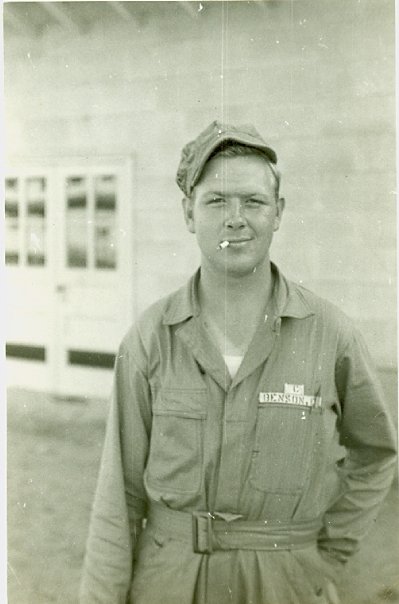
But I am intrigued as I write today, because “all about that bass” is personally memorable to me. You see, I can’t see the word “bass” without thinking of my father, Edward Ludwig Benson, who passed from this world on April 9, 2009 in Tucson, Arizona. My father was a singer, a bass, a basso profundo.

On this Memorial Day, May 25, 2015 I am reminded that for me, it is truly all about that bass.

Dad entered the service just after his father died in the spring of 1942. He was trained an an engineer gunner on the B24, then later detached from his unit and asked to carry the top secret Norden bombsight. He caught malaria in the service, drank water laced with tiny bits of glass and ate rations covered with flies in India; he marched through the jungles in Burma where they machine-gunned poisonous snakes that hung in the trees and would drop down on soldiers to apply their deadly strike. “War is hell,” according to William Tecumseh Sherman (who did more than his part to make his phrase come true).

My father-in-law was a belly gunner on the B17, and did his part in the war as well. But his is another story, for another time. I will call him later today, and thank him for his service; he will turn 91 years old in July. Other family members served as well, and to them I am most grateful.

I was deferred from military service. And I will forever have mixed feelings about that. But that, too, is another story.

Today, I am especially remembering my father. His service to our country was exemplary, and he earned medals to prove it. But his life was my own personal example of what it means to be a man. Not everything about him was perfect. But he was loyal. He was strong. He was responsible.

There is not a day that goes by wherein I do not exhibit some attitude, make some gesture, or quote some phrase I learned from my father. You see . . . it’s all about that bass.

He used to boast that he could sing a bass note (B flat) a half step lower than the famed basso, Ezio Pinza. I inherited his voice. His hands. His nose. His receding hair line. His thin thighs. And much more.

And so, today, I am reminded that it is, indeed, all about that bass.

My life’s foundations. The way I walk. The way I express myself. The way I am shaped. I owe much of it to him.

I could easily say to my father (if he were still living) the words the boy said to his very imperfect father in the movie, October Sky: “I only hope I can be as good a man as you are.”

So, thanks for indulging me in this blog today, as I remember my father gone these last six years. And as I thank him and all the others who have served and are serving this wonderful country of ours. I hope you will reach out to loved ones around you, express your gratitude for the service they have rendered, and thank them for the personal impact they have had on you.

As for me . . . it’s all about that bass.

Edward L. Benson, U.S. Army/Air Force

Edward L. Benson, U.S. Army/Air Force

Posted in Family History, Fathers, Stories, Uncategorized, World War II | Tagged , , , , , , , , , , , , , , , , , , , , , , , , , , | 6 Comments