
I just finished a fabulous book about the beginnings of the American Civil War; the author is none other than the esteemed Erik Larson. It is a 2024 publication filled with information I have never seen before, and it is absolutely enthralling.
One of the central points of the book is to point out the two (or more) divergent points of view regarding the relative importance of “the union” of states in our country versus the ability for each state to choose its own course specifically re: the value of slavery to the southern economy (often couched in terms of states rights). Both sides of the issues were held by upstanding, patriotic, respectable and self-sacrificial persons.
And therein lies the rub! How can “good” people differ to the point of hatred, vehemently desiring to kill each other? How can what is “right” be so seemingly impossible to see?
History is replete with examples . . . but let me mention one I grew up hearing about most: World War 2.

My father was trained as an engineer gunner on the B24, and later carried the top secret Norden bomb site. (BTW my father-in-law was a belly gunner on the B17). In my growing up years the message was plain: there were “good” guys and there were “bad” guys. The Germans = bad; the Americans = good. The Japanese = bad; the British = good. It was as clear as an old cowboy western. You could sometimes even tell which was which by the color of their hat!But in real life . . . it’s not always that easy, is it?
Now it may SEEM easy, but . . . let me tell you a true story.
I was working at the entry to the museum at Memorial Hall, Stone Mountain Park, several years ago. Across the hallway from my podium there was a theater where movies about the Old South and about the granite carving on Stone Mountain would play on a loop. One day a Japanese man emerged from the theater at the conclusion of the movies; clearly he had been taking copious notes on the concluding remarks of the narrator. He was particularly interested in the phrases that described “rising again from the ashes,” etc.
I was intrigued and so I engaged him in conversation. He led tours of Japanese people visiting the states. He wanted to borrow some of the movie’s language because it perfectly described the experience of the Japanese people after the end of WW2, especially with regard to the devastation in Hiroshima and Nagasaki.
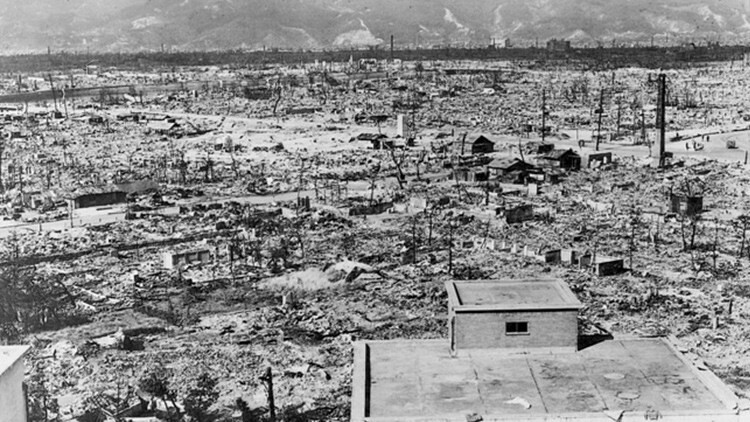
Having visited a work camp in Austria (Mauthausen), and aware of what seemed like the universal belief that Hitler was evil and the Nazi army “bad” I assumed this Japanese man would see (as I did) that his country was the “bad” guy in the war, too.
But he DID NOT!
Much to my naive chagrin he said: “America may have won the war, but that doesn’t mean we were WRONG. All we wanted to do was the same thing Great Britain had been doing for many years – expand.”
I was flummoxed! As we all know, “history is written by the victors,” right? But it had never occurred to me that in this instance there would be ANYONE who would take that position.
Which . . . I think, is a part of Larson’s point in the book. Perspective is colored by numerous factors. And the right or wrong of a situation or belief cannot be determined by the passion and ardor of its proponents or adversaries. Strong beliefs do not equal truth.
So, where does that leave us? Survival of the fittest? Natural selection? Winner takes all?
The French Revolution, the American Civil War, the Tutsi’s and Hutu’s, Idi Amin, the Viet Cong, the Khmer Rouge, Hamas, the Allied and Axis powers, etc. Do we assign rightness or wrongness to these? Of course! Just understand that most (if not all) of these are operating out of a belief that they are in the “right.” That is, they are doing the”righteous” thing in their estimation.
It has been suggested that man cannot successfully govern himself; that there is need of a divine arbiter to regulate behavior. I believe there ARE absolute rights and wrongs. And I am thankful our country was founded on the notion that these absolutes do exist. But it is becoming increasingly hard to delineate these absolutes in modern society.
We really have not changed much since the days of our Civil War. Oh, of course, racism (though still present) is not in vogue anymore. But other erroneous points of view are becoming ingrained in us as surely as a plantation owner’s view of his slaves in 1860.
How does one arrive at what is true? How can you know when a cause is just, righteous, and worth dying for?


 The Lost Story
You will love it, GP!
I’ll put it on my wish list.